The workers behind industrial growth
Small and medium enterprises (SMEs) are one of the most dynamic building blocks of India’s economy and built environment. They are pertinent to create jobs, empower local economies, sustain industrial supply chains, and help give millions of families to procure jobs and livelihoods. However, production or output or industrial contribution to economy cannot solely determine the performance of Industrial sector. It is strengthened by measuring the health and safety of the people who are the main operators the machines, weld steel, handle hot metal, cut parts, paint the surfaces, and work for long shifts. This is particularly crucial in iron and steel manufacturing. The steel fabrication or manufacturing involves exposure to high temperatures, large machinery, sharp materials, electrical systems, welding activities, metal dust, fumes, noise, and strenuous labor. Each hazard can be reduced with engineering controls, personal protective equipment (PPE), health surveillance, and safety training. But in the absence of more than one control measure, a regular working day can lead to a real occupational health hazard. Our research therefore asked a broader question that whether workplace accidents occur: what does the complete occupational environment of workers in SMEs presents considering physical hazards, mechanical risks and psychological well-being all together? This integrated approach was significant because evidence on occupational health in smaller industries, a relatively more informal sector in India, is rare compared to the available evidence for large organized industries.
Bhiwadi as a window into the SME workplace hazards
The study was carried out in the Khuskhera industrial area of Bhiwadi in state of Rajasthan. Bhiwadi is a fundamental and fast-growing industrial cluster. The production environment provides valuable contextual insights into the nature and extent of occupational risks. Scrap metal may be remelted in electric furnaces followed by casting the molted metal into desired or required shapes. The cast components may undergo cutting, welding, grinding, polishing and painting. Organic solvents may be employed during painting processes, while integrated operations, such as painting, welding and furnace operations, may simultaneously generate heat, noise, fumes, and particulate matter. These all processes contribute to the overall occupational exposure profile. One worker could be exposed to excessive noise, inadequate lighting, heat, inadequate ventilation, metal dust, exposed machinery, electrical hazards, and long work hours during the same workday. Under these circumstances, occupational health cannot be viewed as discrete hazards in isolation.
Looking beyond accidents
A cross-sectional exploratory mixed-methods design was used to explore occupational health, safety, and welfare conditions. Steel-sector SMEs were randomly selected from 45 registered industries in the Khuskhera area, from which 10 were chosen. Five workers from each enterprise were selected, for a total of 50 workers from different occupational groups, including machine operators, welders, supervisors, and foremen. The study also evaluated one major industrial facility in the same area to serve as a background reference. Data collection involved a walk-through audit, a structured questionnaire, and group interviews. Where operational conditions allowed, the study assessed environmental conditions by measuring noise, illumination, temperature, and humidity. Existing international questionnaires did not adequately address some Indian SME employment practices, language, and the physical, mechanical, and psychological aspects of risk; therefore, the study developed a context-specific instrument that was translated and back-translated, piloted, and validated for reliability through expert review. This is important because occupational health cannot be understood simply by counting injuries. Knowledge of hazards, protective equipment, rest, medical support, and psychological distress is a part of the same occupational health system.
A young, mobile, and economically vulnerable workforce
The workforce was very young. Fifty-two per cent of the 50 workers were aged 20-25 years, and another 32% were below 20; none were older than 35. The educational profile of the workers was also relatively inadequate, with 54% of them having secondary education, 28% having only primary education, and only 12% holding technical diplomas. Further, most of them have migrated from Uttar Pradesh (58%), Bihar (26%), and Jharkhand (12%), with little being the local residents. This workforce profile is an important consideration in assessing occupational safety and risk. Technical education influences the worker’ capacity for hazard identification and risk recognition, while migrant workers may have limited access to weaker local support networks and fewer alternatives when exposed to poor or adverse employment conditions. Therefore, safety interventions in such workplaces must be designed according to the characteristics, needs and vulnerabilities of the workers actually employed in these settings rather than an idealized industrial worker.
When a long working day becomes a hazard
One of the clearest concerns was working duration. Only 17% of workers work 8 hours per day. In contrast, 57% reported working 12-hour shifts, 23% reported working about 10 hours, and fewer worked more than 12 hours. Overall, 83% exceeded an 8-hour shift, and workers who worked more than eight hours per day reported more health complaints. Exposure should not be separated from working time. After 10 or 12 hours, a noisy machine, a hot furnace, or even some solvent fumes can have more consequences. Long shifts can result into fatigue, reduced concentration, and slower reaction times. In environments with sharp objects, heavy machinery, hot surfaces, and electrical hazards, fatigue can itself become an additional occupational safety risk, increasing likelihood of errors, accidents and injuries.
“A hazard is shaped not only by how dangerous the exposure is, but also by how long, how often, and under what conditions a worker experiences it.”
Noise, heat, lighting, and Ventilation
Noise is a significant physical hazard in the workplace that often goes un-noticed. Measurement taken across different work areas ranged from approximately 88 dB to 105 dB and 85% of measured locations exceeded the 85 dB occupational noise exposure limit used as a reference level in this study. Hearing protection was rarely used, and 26% of the workers reported hearing impairment. Occupational hearing loss is of particular concern because it often develops gradually and may become permanent before the extent of impairment gets recognized. Other workplace conditions further exaggerate the occupational burden. Nearly 70% of the work areas were inadequately illuminated. Temperatures around the furnaces and welding operations ranged from approximately 35°C to 48°C, with 60% of work areas exceeding safe working temperature limits during peak working hours. Mechanical ventilation was absent in approximately 80% of the facilities, and poor ventilation was associated with respiratory health complaints. These hazards interact to amplify overall occupational risk. Increased heat intensified fatigue, inadequate lighting increased the chance of errors near cutting equipment, and poor ventilation increased exposure to fumes, dust, and solvents. These risks were further exacerbated during longer working hours or shifts.
Mechanical hazards and the PPE gap
Mechanical hazards were also a major concern in the assessed workplaces. Approximately 68% of the machines examined did not have adequate guards or protective barriers. Visible electrical hazards were observed in 45% of the relevant connections. Poor housekeeping facilities were identified in nearly 90% of the facilities, with oil spills, metal shavings, and other obstructions present in the work areas. Heavy materials were also frequently handled manually without appropriate mechanical assistance, increasing the possibility of musculoskeletal injuries and accidents. The findings related to personal protective equipment (PPE) perhaps most clearly demonstrated the gap between known prevention and their implementation in the workplace. 52% of workers used no protective equipment. 32% used eye protection, 16% wore safety shoes, 12% used gloves, and 8% used respiratory protection. Among surveyed workers, no one wore occupational hearing protection despite being exposed to high noise levels. Seven out of ten SMEs did not provide any PPE, while only one SME provided comprehensive PPE. The difference in injuries was significant. Injury prevalence was 37.5% among workers using PPE, and 65.4% among workers not using PPE. The study’s logistic regression also showed that non-use of PPE was an independent predictor of injury (OR = 3.8; 95% CI: 1.6-9.1). Although PPE should never replace engineering controls, where welding, cutting, grinding, and handling metal cannot be avoided, the right PPE provides a protective barrier.
The human consequences behind the statistics
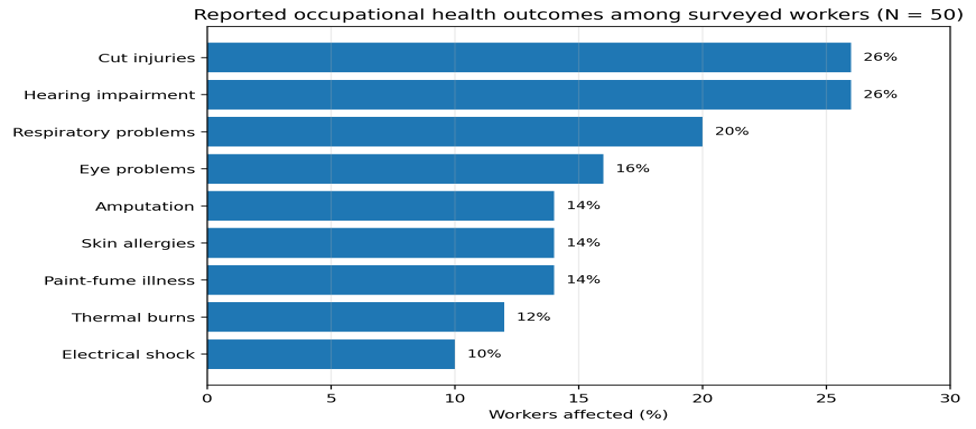
The most important findings were the health consequences workers experienced. Cut injuries and hearing impairment affected 26% of surveyed workers each. Respiratory problems were reported by 20%, eye problems by 16%, amputations by 14%, skin allergies by 14%, paint-fume-related illness by 14%, thermal burns by 12%, and electrical shocks by 10%. Overall, 72% of surveyed workers experienced at least one work-related health issue. These percentages represent more than clinical categories. A cut injury can reduce a worker’s ability to earn; hearing impairment may be permanent; an amputation can create lifelong disability. In a low-income or informal employment setting, occupational injury can affect an entire household, not only the individual worker.
The overlooked dimension: psychological health
One of the most revealing findings concerned a less visible form of occupational risk. Eighty-six per cent of workers were either unaware of psychological occupational-health effects or gave a neutral/no-effect response. Among those who did recognize psychological problems, sleep disturbance, hypertension, and job dissatisfaction were reported. Qualitative analysis also identified psychological-health stigma and unawareness, economic pressure overriding well-being, normalization of workplace stress, and lack of support systems. A low rate of reported psychological problems should not automatically be interpreted as excellent mental well-being. When awareness is limited, workers may not recognize persistent stress, sleep disturbance, or emotional exhaustion as occupational health problems. Modern occupational health must therefore protect both the body and the mind.
“What workers do not recognize as an occupational health problem can remain invisible, even when it is affecting sleep, stress, well-being, and the ability to work safely.”
Welfare, emergency preparedness and health surveillance
Workers’ protective equipment is not the only part of occupational health. Employee State Insurance coverage and basic sanitation facilities were available, but other welfare provisions were limited. Only 30% of the SMEs had lunch facilities. None of the facilities maintained appropriate first-aid facilities or designated rest areas, and there were no arrangements for transporting injured persons. Similarly, work uniforms and formal occupational safety training programmes were not provided. Emergency preparedness was particularly poor. The average distance to the nearest hospital was about 12.5 km, with injured workers relying on private cars or auto-rickshaws to reach the hospital. The estimated time required to reach medical care was 25 to 40 minutes while none of the workers and even the supervisors had received basic first-aid training. A systematic health surveillance program was also lacking. None of the ten SMEs conducted any pre-employment health examinations for production workers or periodic occupational health examinations. Even the occupational health records were not maintained. In the absence of baseline and periodic health screening, conditions such as progressive hearing loss, respiratory disease, and other work-related health problems may remain undiagnosed until they become more severe or result in significant health impairment.
What the large-industry comparison taught us
The comparison with a large-scale industry operating in the same geographical region provided useful context for interpreting the findings. The larger organization employed a dedicated environmental health and safety professional and had several formal occupational safety and health measures in place. These included pre-employment and periodic health screening, comprehensive provision of PPE, first aid and CPR training, ambulance support, adequate ventilation and lighting, and regular safety training programmes. The contrast suggests that the occupational safety gap is more than something unavoidable consequence of manufacturing activities in the region. Although, the comparison included only one large-scale industry, requiring cautious interpretation, it indicates that implementation of improved occupational-health and safety systems are possible within the same broad regulatory and geographic environment.
| Indicator | SME average | Large-scale comparison |
| Injury rate (per 100 workers/year) | 47.8 | 2.1 |
| PPE compliance | 48% | 98% |
| Health-screening coverage | 0% | 100% |
| Annual safety training | 0 h/worker | 24 h/worker |
| Safety investment | ₹450/worker/year | ₹8,500/worker/year |
| Injury-related cost | ₹6,800/worker/year | ₹1,200/worker/year |
From identifying problems to building solutions
The findings indicate a clear hierarchy of practical interventions for improving occupational safety in SMEs. Immediate worker protection should begin with proper selection, provision and use of PPE supported by adequate training and supervision. Engineering controls should focus on improving ventilation, machine guarding, noise control, electrical safety, workplace lighting, and safer material handling practices. Administrative controls should encompass regular safety training, pre-employment and periodic health surveillance, systematic occupational-health records, adequate rest periods, and effective emergency-response arrangements. Strengthening worker awareness is equally important, particularly regarding occupational hazards, safety rights, proper use of PPE, and the importance of reporting early symptoms workplace illness or injury. Regulatory implementation and compliance also need to be strengthened to recognize the resource constraints of SMEs. Smaller enterprises may not lack the financial resources, technical expertise and infrastructure to establish in-house occupational health and safety systems as large organizations. Cluster-based services, shared safety professionals, pooled PPE procurement, mobile occupational-health clinics and joint training programmes can provide feasible and sustainable solutions in this direction. The question should therefore be, not whether a small company can afford occupational safety, but how occupational safety can be designed and delivered so that effective protection for every enterprise, regardless of its size can be achieved.
Safety is an investment, not merely compliance
A persistent misconception in resource-limited enterprises is that safety represents an additional expense rather than a necessary investment. However, the consequences of occupational injuries extend beyond the immediate medical costs, lost work time, production interruption, compensation payments, employee turnover, and loss of experienced and skilled employees. The contextual comparison in this study indicated that that despite the substantial investment in occupations safety per worker in large industry would make the injury related costs much lower than the SMEs’ average. Although a comparison involving a single large-scale industry cannot establish a universal economic relationship, it provides an important practical lesson that reduced expenditure on preventive does not necessarily result in lower overall costs. Occupational safety should therefore be better understood as an investment in worker protection, organizational productivity, and organizational resilience.
Where research must go next
This study serves as a baseline assessment of occupational health and safety in India’s SME steel sector rather than a definitive evaluation of the sector as whole. It included 50 workers from 10 SMEs located within a single industrial area, along with one large-scale facility used for contextual comparison. The cross-sectional design limits the establishment of causal relationship as approximately 15% of planned instrumental measurements could not be completed due to operational or safety constraints. These limitations should be considered when interpreting the findings. Further studies should therefore involve larger and geographically diverse populations to provide a broader understanding. Longitudinal studies would be more appropriate to track or have insights into how hearing, respiratory health, musculoskeletal problems, and psychological well-being evolve with continued exposure. Intervention-based research can evaluate the effectiveness of measures such as subsidized PPE, improved ventilation, machine guarding, shorter shifts or structured safety training in reducing workplace injuries and health complaints. Multi-regional work across different industrial clusters can help develop context-specific yet scalable and applicable intervention strategies.
The larger message
India’s manufacturing ambitions and the welfare of industrial workers should not be viewed as competing objectives rather they are fundamentally interconnected. A productive industrial system depends on healthy, capable and skilled workforce. Our Bhiwadi study identified substantial gaps including inadequate PPE, unsafe machinery, excessive noise exposure, poor ventilation and lighting, prolonged working shifts, absence of health surveillance, weak emergency preparedness, and extremely limited recognition of psychological health. At the same time, it points to practical and well-established preventive measures. Appropriate PPE, machine guards work, adequate ventilation, safety training, health surveillance, First-aid preparedness can substantially strengthen worker protection. The key challenge is ensuring that these established measures move from policy documents and large corporate plants into the everyday reality of smaller industrial workplaces. When a young worker enters a factory, earning a livelihood should not require accepting preventable hearing loss, respiratory disease, burns, amputations, or chronic psychological stress as unavoidable consequences of employment. Building a stronger culture of prevention is therefore not merely an occupational-health objective; it is an essential component of responsible and sustainable industrial development in India.