Beneath every plant lies the rhizosphere, the narrow zone of soil surrounding the roots where plants and microbes constantly exchange chemical signals. Plants release a significant proportion of the sugars they fix through photosynthesis into this zone as root exudates, thereby supporting a dense community of bacteria and fungi. In return, many of these microbes help plants acquire nutrients, defend against pathogens, and tolerate abiotic stresses such as drought and salinity.
High-throughput sequencing enables us to explore these communities directly, without growing each microbe in a lab, which matters because most soil microbes cannot be cultured. Recent findings show that the rhizosphere microbiome is dynamic. Its composition shifts as a plant grows from seedling to flowering to maturity, and it is shaped by soil type, climate and geography as well as by the host itself.
“Rhizosphere microbiome is not fixed. Its composition shifts as a plant develops from seedling to maturity”
Roots, microbes and the future of food: why the hidden half matters
Plant microbiome research explores the vast communities of bacteria, fungi and other microbes that live in and around plants, especially in the rhizosphere. It sits at the meeting point of microbiology, genomics, ecology and agriculture, and its importance has grown sharply in recent years.
The world must feed a growing population while climate change brings heat, drought and salinity to farmland. For decades, higher yields have relied on synthetic fertilizers and pesticides, but their excessive use degrades soil, pollutes water and harms biodiversity. Microbes offer a gentler alternative. Some fix atmospheric nitrogen, others release locked-up phosphorus, produce growth hormones or shield roots from pathogens.
Harnessing these helpers requires understanding them first: who they are, what they do, and how they respond to the plant, the soil and each other. By decoding these hidden partnerships, researchers aim to design microbial inoculants and farming practices that raise yields while restoring, rather than depleting the soil.
From culturing to metagenomics: milestones in understanding the rhizosphere
The biggest leap came from genome sequencing, which lets us survey entire soil communities without culturing the microbes. Studies across several plants have since shown that the rhizosphere is far from random. Plants shape it through root secretions, and its composition shifts with the plant’s growth, species, soil and geography. Comparisons of wild and domesticated crops suggest that breeding may even have changed which microbes plants recruit.
Researchers have also moved from asking “who is there” to asking “what they are doing”. Combining gene and gene-activity data reveals microbial functions that are switched on in roots, from nutrient cycling to stress protection. Newer tools can also distinguish individual strains within a species, which matters as closely related species can differ in functions whether they aid in plant development or acts as a pathogen. Finally, scientists have begun to decode the chemical conversations between plants and microbes, including signals that recruit symbiotic partners. Synthetic communities built from selected microbes now allow these interactions to be tested directly.
Mapping the partnership
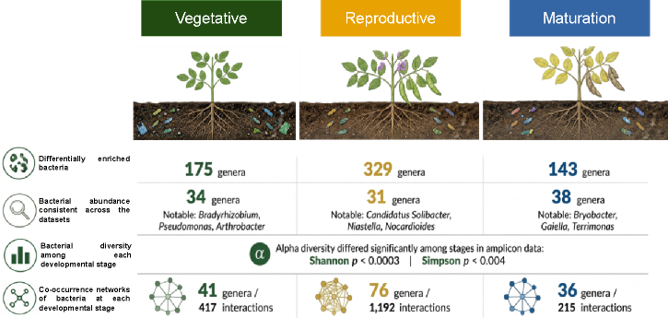
The rhizosphere is complex and varies enormously between locations, plants and growth stages. Our work has tried to explore and understand this complexity . First, we asked whether plant development influences microbial diversity. By combining sequencing data from a larger number of samples across the globe comprising of eight legume species, we showed that rhizosphere communities shift between the vegetative, reproductive and maturation stages. We identified ten marker bacteria tied to particular stages, several linked to better nodulation, longer roots or earlier flowering. We also found that geography shaped these communities even more strongly than growth stage. By tracking which bacterial genes were active, we moved from a simple census toward understanding function .
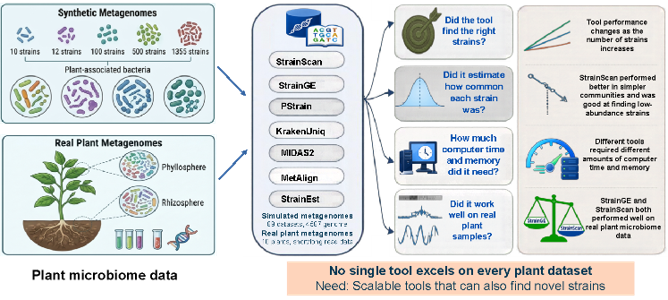
Second, we tackled the strain problem. Knowing that a bacterial species, such as Ensifer medicae or Pseudomonas fluorescens is present, tells us little, because one strain may fix nitrogen or protect the plant while its close relative may cause a disease. Yet nearly all strain-tracking tools built were tested on the human metagenomes only, which is far simpler than the plant environment, where diversity is higher, host DNA contaminates samples and many microbes are poorly characterized. So, we benchmarked seven of them on simulated and real plant datasets. Two tools, StrainScan and StrainGE, performed best, yet none excelled everywhere. This gives researchers practical guidance and a clear call for better methods.
Beyond the census: gaps between the lab and the field
Despite rapid progress, the rhizosphere microbiome remains a challenge. A root zone can hold thousands of microbial species, many still unnamed, and its composition varies with soil, climate, geography and the plant development. Disentangling these overlapping influences requires large, standardized datasets, yet most studies still focus on a single crop at a single site.
A second gap is resolution. Telling strains apart is essential, but available tools were largely designed for the human gut. They rely on reference genomes, so they cannot recognize strains that have never been sequenced, a serious limitation in soils full of unknown organisms. Their accuracy also falls as communities grow more diverse, and some demand days of computing time or very large memory.
Third, association is not causation. Many microbes correlate with better growth, but proving what they cause, requires controlled experiments. Moreover, sequencing shows presence, while measuring activity in the field remains harder. Finally, moving from discovery to application is slow. Microbial inoculants often perform inconsistently outside the lab, and newer ideas, such as using nanoparticles to attract helpful microbes, raise unanswered questions about how they work, whether they accumulate in soil, and how they affect it over many years.
Promise with patience: reading the field honestly
Plant microbiome research is a young field with real promise, but we should treat it as a work in progress rather than a ready-made solution. A plant is no longer seen as a lone organism growing in lifeless dirt, but as one half of a partnership with the life around its roots. This idea is now well supported, and it is changing how we think about plant health, nutrition and resilience.
It helps to separate what is settled from what is still emerging. Settled: microbes influence how plants absorb nutrients and resist disease, and plants in turn actively shape their microbial neighbors. Emerging: which partners matter at which moments of a plant’s life, and how the chemical signals between them work. Still speculative: deliberately engineering these relationships at scale.
We should also know that progress is collective. It draws on biologists, chemists, soil scientists, computer scientists and farmers, and depends on researchers openly sharing data so that findings can be compared across crops and geographical locations. The field’s greatest gift so far is a new way of seeing agriculture, one that treats soil as living infrastructure worth protecting.