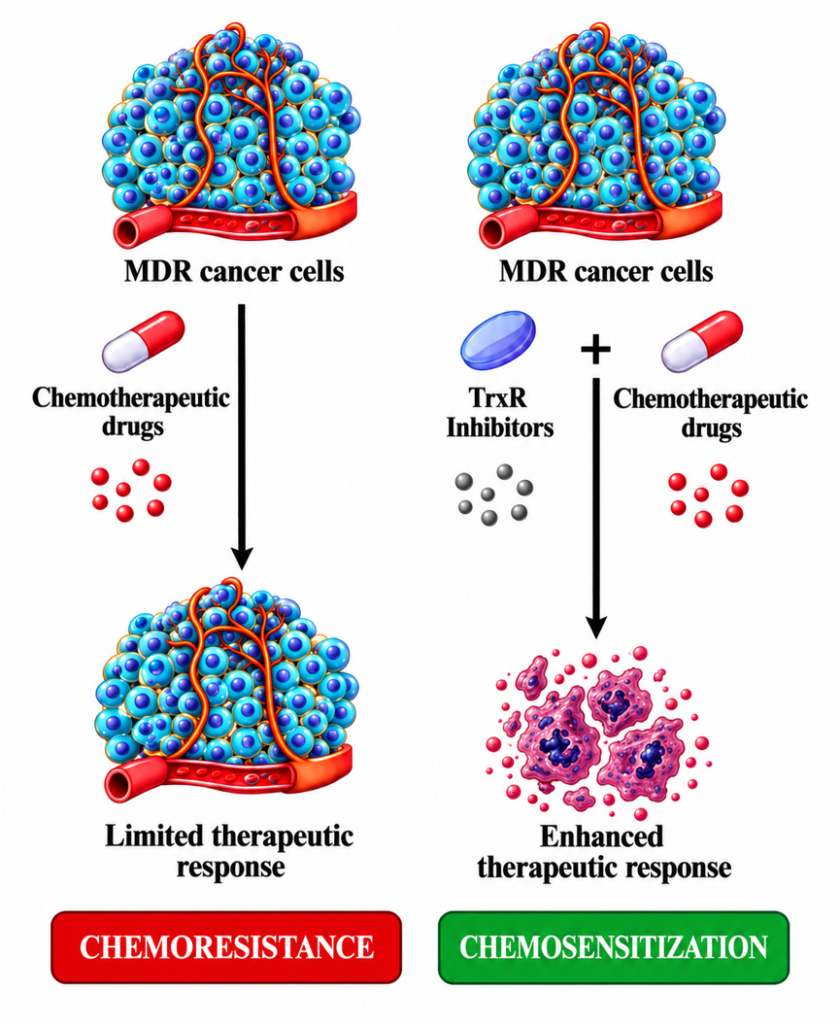
Why does chemotherapy stop working? One of the greatest challenges in cancer treatment is not simply finding drugs that kill cancer cells, but understanding why some cells survive treatment. Chemotherapy may initially shrink a tumor, yet resistant cancer cells can persist, multiply and contribute to relapse. Cancer cells exhibit resistance to structurally and functionally different anticancer drug, this phenomenon, known as multidrug resistance (MDR), and it remains a major obstacle to effective cancer treatment. Cancer cells can develop several defense mechanisms. Some use drug transporters to pump chemotherapy agents out of the cell, while others strengthen antioxidant systems, repair DNA damage or alter their metabolism. Together, these adaptations create a complex survival network that allows cancer cells to withstand treatment. Our laboratory has investigated how these defences might be weakened to restore chemotherapy sensitivity. Rather than focusing exclusively on discovering new anticancer drugs, we ask a complementary question: can existing medicines disrupt the mechanisms that protect resistant cancer cells? This approach has guided our research into drug repurposing, thioredoxin reductase (TrxR), NRF2–Keap1 signaling, FOXO3 and P-glycoprotein (P-gp), a transporter associated with drug efflux.
“Chemotherapy resistance is not one lock with one key; it is a network of interconnected cellular defense mechanisms.”
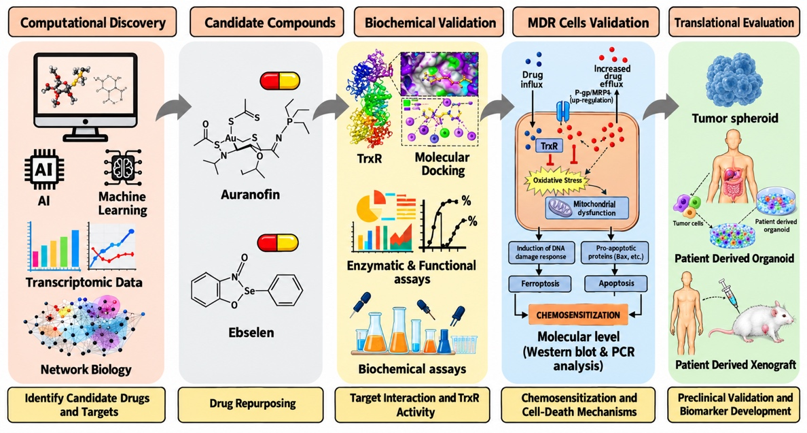
Turning Existing Medicines into New Cancer Tools. Developing a new cancer drug is expensive, time-consuming and uncertain. Drug repurposing offers an alternative by investigating whether medicines developed for one condition could benefit patients with another. Existing pharmacological and safety information may help guide this process, although new indications still require rigorous testing. Our work on drug repurposing in oncology has explored how molecular docking, artificial intelligence (AI), machine learning, transcriptomic analysis and network biology can help identify promising drug–target relationships and potential combinations. Computational predictions, however, are starting points rather than proof of therapeutic effectiveness. Biochemical experiments, cell based studies and appropriate animal models are needed to establish whether predicted effects occur in biological systems. We are employing multidrug resistant cancer cells and drug-resistant tumor xenograft models for making cancer cells sensitive to chemotherapy.
The Redox System: Cancer’s Internal Fire-Fighting Network. Reactive oxygen species (ROS) can be compared to cellular sparks. At controlled levels, they participate in normal signaling; when they accumulate excessively, they can damage DNA, proteins, membranes and mitochondria. Chemotherapy can increase oxidative stress, making the capacity to control ROS an important determinant of cancer-cell survival. Two components of this defense network are NRF2 and TrxR. NRF2 regulates genes involved in antioxidant protection and cellular detoxification. Keap1 normally helps control NRF2 activity, but oxidative stress can alter this regulation, allowing NRF2 to activate protective genes. TrxR maintains cellular redox balance and supports antioxidant systems. FOXO3 is another stress-responsive regulator whose effects depend on the cellular context. When these pathways become dysregulated, cancer cells may gain an advantage in surviving treatment. Our research has therefore examined redox regulation as a connected system rather than treating individual antioxidant proteins as isolated targets. The central question is whether disrupting these defences can expose vulnerabilities that chemotherapy alone fails to exploit.
From Auranofin to Ebselen: Exploring Redox Vulnerability. Our more recent experimental work investigated ebselen, a repurposed compound with TrxR-inhibitory activity, in combination with doxorubicin in MDR cells. The combination enhanced doxorubicin activity and increased oxidative DNA damage. It also increased markers of lipid peroxidation and altered iron-related responses while reducing important antioxidant defences, including glutathione peroxidase 4 (GPX4). Experiments using deferoxamine, an iron chelator, and ferrostatin-1, a lipid radical-trapping agent, provided additional evidence supporting the involvement of ferroptosis. Ferroptosis is a form of regulated cell death driven by iron-dependent lipid damage. Unlike apoptosis, it is particularly associated with the failure of systems that protect cellular membranes against lipid oxidation. Our findings suggest that weakening redox defences may make resistant cancer cells more susceptible to this process, alongside other forms of cell death. These results are promising, but they do not establish that ebselen is an effective treatment for patients with resistant cancers. Further research is needed to clarify the mechanisms involved, establish therapeutic selectivity and assess safety and efficacy in clinical settings.
The Other Side of Resistance: Cancer Cells Throw the Drug Away. Another major resistance mechanism involves P-gp, encoded by the ABCB1 gene. This transporter uses cellular energy to remove certain drugs from cells, reducing their intracellular accumulation and potentially limiting their effectiveness. Our ebselen–doxorubicin combination treatment study found reduced ABCB1/P-gp expression alongside increased intracellular doxorubicin accumulation. At the same time, the combination altered TrxR-associated redox defences and increased markers consistent with ferroptotic damage. These observations connect two important aspects of resistance: reduced intracellular drug exposure and enhanced protection against drug-induced damage. Targeting both mechanisms may offer a more comprehensive approach than addressing either one alone. However, changes in transporter expression and drug accumulation do not, by themselves, establish the precise contribution of P-gp inhibition to the overall response.
A New Way of Thinking About Chemotherapy Resistance. Together, our studies support a broader view of MDR as a network of interconnected defences. Drug efflux can limit chemotherapy exposure; antioxidant pathways can reduce oxidative damage; GPX4 can protect membranes from lipid peroxidation; and iron regulation can influence susceptibility to ferroptosis. Our work with auranofin helped establish the rationale for investigating TrxR as a potential vulnerability. Our research on redox signaling broadened this perspective to pathways involving NRF2, Keap1 and FOXO3. More recently, our ebselen–doxorubicin study linked redox disruption with iron dysregulation, ferroptosis-associated changes and altered P-gp expression. The common principle is that overcoming resistance may require targeting several cooperating survival mechanisms rather than relying on a single molecular target.
From Laboratory Findings to Patient-Relevant Research. Cancer-cell cultures provide valuable mechanistic insights, but they cannot reproduce the complexity of human tumors. Tumor blood vessels, immune cells, connective tissue, oxygen availability and differences between cancer-cell populations can all influence treatment response. Our ebselen–doxorubicin research extended beyond cell culture to a multidrug-resistant xenograft model, where the combination produced substantial tumor-growth suppression under the experimental conditions tested. No significant changes in body weight or evident histopathological abnormalities were observed in the examined organs. These findings provide preliminary in vivo support, but they do not establish long-term safety or clinical effectiveness. Future studies should incorporate more representative models, including three-dimensional tumor cultures, patient-derived organoids and suitable animal systems, to determine whether the observed effects persist in more complex biological environments.
The Future: Treating the Defence System, Not Just the Tumor. The next challenge is to identify which tumors depend most strongly on particular resistance mechanisms. Some may rely heavily on TrxR-associated redox protection, while others may be dominated by P-gp-mediated drug efflux or GPX4-dependent protection against lipid oxidation. Biomarker-guided chemosensitisation could help identify tumors most likely to respond to specific combinations. Candidate markers include TrxR activity, NRF2–Keap1 pathway alterations, glutathione status, ABCB1/P-gp expression and ferroptosis-related indicators. Their predictive value must be established through further validation. Across our research, the focus has progressed from investigating repurposed compounds such as auranofin to examining redox signaling and the effects of ebselen combined with doxorubicin. Computational drug discovery provides a framework for extending this work to additional compounds and combinations. Ultimately, the goal is not simply to find another drug that kills cancer cells. It is to understand how resistant cancer cells survive and identify ways to weaken those defences. By combining drug repurposing, redox biology and experimentally validated computational approaches, we hope to contribute to more targeted strategies for overcoming chemotherapy resistance.