The Challenge: Treating Cancer Without Harming Healthy Tissue
Cancer develops when cells in our body are dysregulated. For decades, our approach to treat cancer has felt like “fighting a kitchen fire with a flood”. Cancer cells exist within the same complex biological environment as healthy cells, therefore traditional treatments like chemotherapy destroy healthy cells along with deregulated cells. Imagine a future where medicine is traveling through blood stream silently without causing a single side effect and latching only onto tumor cells, until a doctor shines a harmless beam of light on exact site and it activates killing of tumor cells. This is not science fiction; this is an emerging discipline of light responsive nanomedicine.
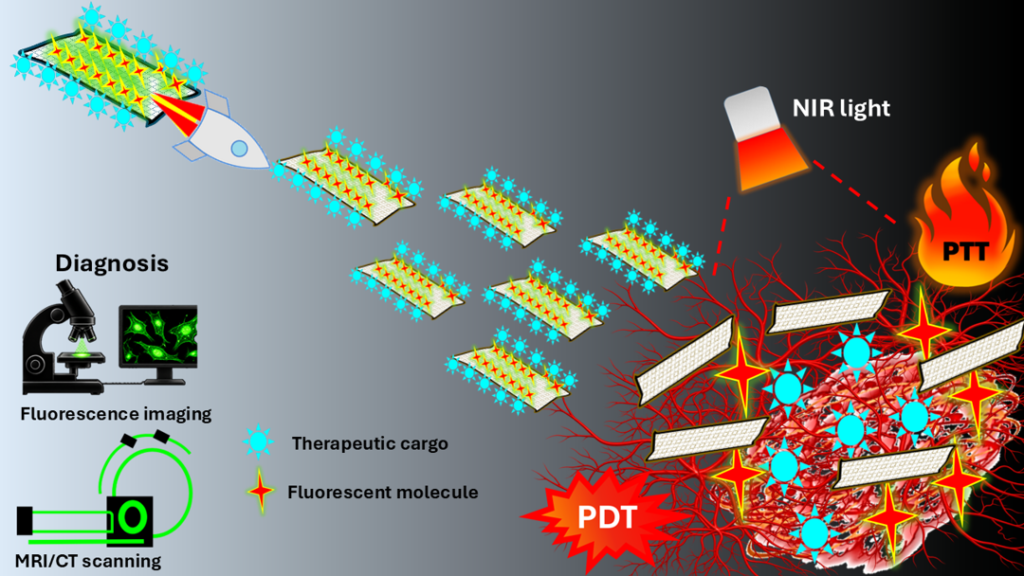
Nanomedicine is the branch of medicine that uses materials engineered at microscopic scales, a size that is thousand times smaller than human hair, to treat, diagnose and monitor diseases from inside the body. At this microscopic level, scientists can design a material that can act as tiny delivery vehicles and deliver the cargo at precise locations. What is even more amazing is the rise of field of theranostics where these nanomaterials can package diagnosis and therapy into every single unit. This packaging saves the patients from going through grueling cycles of diagnosis and therapy separately. Going one step further, these packages can be tailored to the specific needs of the individual patient, choosing the cargo based on the specific type of cancer and its stage. Finally, when these materials are loaded with desired cargo and injected into the body, they can be activated with precision using different external stimuli like magnetic field, ultrasound, temperature, electric field and light.
“For decades, our approach to treating cancer has felt like fighting a kitchen fire with a flood.”
Light as a Switch for Cancer Therapy
Among various stimuli, light is particularly attractive as therapeutic trigger because it can be delivered at a defined location and time. The important point, however, is that the light used must be able to reach the target tissue, and the therapeutic response must be generated efficiently without causing unacceptable damage to surrounding tissues. In the electromagnetic spectrum, near-infrared (NIR) wavelengths are particularly well suited for this role. Unlike visible or ultraviolet light, NIR wavelengths (roughly 700–2500 nm) penetrate several centimeters into soft tissue without being strongly absorbed by water or hemoglobin. This “biological transparency window” means NIR light can reach tumors non-invasively while leaving surrounding tissue largely undisturbed and it can be switched on and off with millimeter-scale precision, giving clinicians a level of spatial and temporal control that few other trigger mechanisms offer. The challenge has never really been light; it’s been building a material that responds to it usefully.
Most light responsive cancer therapies so far work through in any one of the two mechanisms. Photothermal therapy (PTT) uses light absorbing nanomaterials to convert NIR energy into localized heat, thermally damaging tumor cells. Photodynamic therapy (PDT) instead uses a photosensitizer, a molecule/material that becomes chemically reactive when exposed to light. This photosensitizer, when excited with light, generates reactive oxygen species causing oxidative damage in tumor cells. Each PTT and PDT has real clinical promise and each has real limitation. PTT can under-treat tumor margins where heat dissipates, while PDT depends heavily on tissue oxygenation, which is often poor in the hypoxic core of solid tumors. Combining the two mechanisms therefore offers a compelling possibility: a single light stimulus could generate complementary forms of cellular stress within the same therapeutic platform. The central question then becomes: Can one material be molecularly engineered to perform both functions efficiently, while also incorporating diagnostic capabilities?
Molecular Architecture: Building a Multifunctional Platform
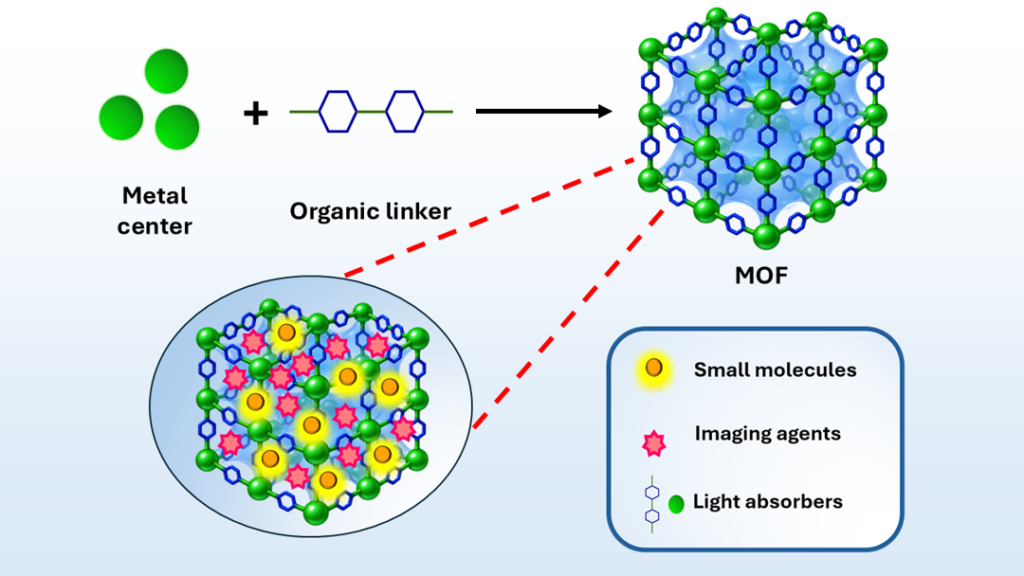
This is where metal-organic frameworks (MOFs) offer a genuinely uncharted and unique design space. MOFs are microscopic sponge like molecular LEGO cages built from metal ions and organic molecules. The most exciting part of MOFs is their modular design and multifunctionality. Just like selecting different LEGO blocks, scientists can mix and match thousands of organic linker molecules and metal ions to build a customized cage. MOFs can be customized for cage size, stimuli, pore size and safety profile. Since they are sponge like porous materials, MOFs have very high surface area. Scientists can pack cancer fighting drugs and diagnostic imaging agents for theranostic purposes. On the other hand, MOFs can also be designed in such a way that PTT, PDT and imaging modality are intrinsic to the MOF making them multifunctional.
In our recent work, we took this modular concept in an unconventional direction by using tetraniline (TANI) as the organic linker for a nickel-based metal organic framework. TANI is a conjugated oligoaniline linker with no prior precedent as a primary MOF-coordinating ligand. TANI’s extended conjugation gives the framework strong, broad NIR absorption, which drives efficient photothermal conversion. At the same time, the assembled framework generates Type I reactive oxygen species under NIR irradiation, providing a photodynamic effect that doesn’t depend on the same oxygen-rich conditions PDT normally requires. The nickel centers, meanwhile, offer a route toward imaging functionality, so the framework’s therapeutic action and its visibility to imaging techniques come from the same underlying structure rather than requiring separate agents bolted together. The result is a single nanoplatform where photothermal and photodynamic mechanisms operate concurrently rather than sequentially, with a shared trigger, one wavelength of light, one material, multiple modes of action. That multifunctional, combinatorial design, rather than any single mechanism in isolation, is what makes this class of material interesting.
Multifunctionality is not just a buzzword, but its biological rationality is concrete. Tumors are heterogeneous, different regions of the same mass vary widely in oxygenation, vascularization, and cell density. A therapy that only works well under one set of conditions will inevitably underperform somewhere in that tumor. Combining PTT and PDT within one platform means the treatment isn’t solely reliant on tissue oxygen availability. The heat generated by the photothermal component can raise the local temperature enough to kill tumor cells, while potentially improving local blood flow and oxygenation. This in turn can make the photodynamic component more effective, a self-reinforcing loop rather than two independent treatments competing for the same light dose. Given the LEGO cage kind of structure MOFs are easier to build as a multifunctional vehicles compared to other nanoparticles.
From the Laboratory to the Clinic
One should be very cautious and none of this should be read as a claim that NIR responsive nanomedicine is close to standard clinical use and this gap is worth being honest about. Most work in this space, including our own, is still at the level of in vitro and early in vivo demonstration. Moving toward clinical relevance requires understanding few more questions about interaction between material and complex biological environment, how these materials clear from the body, what their long-term biocompatibility is and what their degradation products are. Another important consideration is whether NIR penetration is sufficient for anything beyond superficial or endoscopically accessible tumors. The primary roadblock is that deep-penetrating infrared light lacks the raw energy needed to trigger cancer-killing reactions, forcing researchers to build incredibly complex nanoparticles that are difficult to manufacture and hard for the body to clear safely. However, MOFs offer a promising breakthrough because their unique, customizable “LEGO-like” structure allows scientists to perfectly mix and match materials like packing tiny energy-multiplying “antennas” and protective components into a single cage. While it remains a difficult scientific hurdle, this ultimate adaptability is exactly why researchers believe MOFs could finally bridge the gap between advanced physics and safe, real-world medicine.
Perhaps the broader significance of this work lies not in any single performance metric, but in a shift in the underlying question. Traditional pharmacology asks what molecule can kill the cancer cell. Nanomedicine adds a second question: how can we control where and when that molecule, or that mechanism, becomes active? The MOF platform described here is one illustration of that shift, but the principle it points to is larger than any one material. The aim isn’t to build increasingly elaborate nanoparticles simply because they can perform more functions; it’s to build toward a future where cancer treatments are precise by design, not by accident. Getting there will take sustained, unglamorous work, on targeting, pharmacokinetics, degradation, and scale-up, across the platforms that carry this principle forward. But the underlying idea, light as a switch and chemistry as the circuit, is one worth continuing to build on.