The question after restriction
Dietary discussions in autism spectrum disorder (ASD) often begin with removal: gluten, casein, processed foods or other foods considered difficult to tolerate. Yet for a child who already has food selectivity, sensory sensitivities or a narrow repertoire, the more practical question may be what comes next. What can replace the foods that have been removed, and can those replacements be accepted, nutritionally meaningful and sustainable for the family?
This distinction matters particularly for gluten-free and casein-free (GFCF) diets. Interest in GFCF diets remains substantial, but controlled evidence has not established them as a treatment for the core features of autism. A systematic review and meta-analysis of six randomized controlled trials involving 143 children found no statistically significant effect on clinician-reported core symptoms, parent-reported functional level or behavioral difficulties; the certainty of evidence was low to very low. The authors also noted potential gastrointestinal adverse effects and emphasized the need for better-quality trials.
A clinically responsible discussion should therefore move beyond the binary question of whether a restrictive diet “works” and examine how dietary care can remain nutritionally and practically sound when restriction is chosen.
“A dietary intervention begins with restriction only if it ends with a food repertoire that the child and family can actually sustain.”
From food elimination to food reconstruction
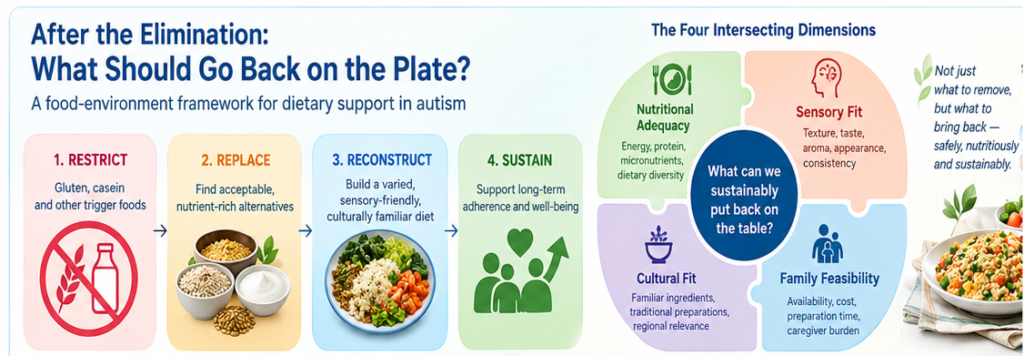
Our view is that dietary intervention in autism should increasingly be considered as food-environment design. Removing a food is only the first step. The intervention becomes meaningful when the resulting food repertoire is reconstructed. Four dimensions should be considered together. First is nutritional adequacy: replacement foods must contribute appropriately to energy, protein, micronutrients and dietary diversity rather than simply satisfy a restriction. Second is sensory fit: texture, taste, aroma, appearance and consistency can determine whether a food reaches the child’s plate. Third is cultural fit: familiar ingredients and household preparations may reduce the distance between a prescribed diet and everyday eating. Fourth is family feasibility: ingredient availability, cost, preparation time, cooking skills and school or social contexts can determine whether a diet can be sustained. This reframes adherence. It is not simply whether a caregiver follows instructions; it is whether a dietary strategy can become part of the child’s ordinary food environment.
Why millets are interesting but not magical
Millets are relevant to this reconstruction model because they are traditional grains that can be incorporated into diverse foods and can fit gluten-free dietary patterns. The FAO describes millets as diverse dryland cereals that can provide dietary fiber, minerals, vitamins and protein, with composition varying by species, variety and growing conditions. Our earlier work on nutri-cereals in autism examined their nutritional significance, food formulation, processing considerations, sensory and cultural acceptability, and the need to protect overall nutritional adequacy. The important point is not that millets possess a special therapeutic property for autism. Rather, they can function as a food platform. Foxtail, little and pearl millet can be formulated into familiar or adaptable preparations, allowing dietary restriction to be addressed without making the food environment entirely unfamiliar.
This distinction is essential. Nutritional plausibility is not clinical efficacy. Biological hypotheses involving dietary fibre, resistant starch, polyphenols, microbial metabolites and the gut–brain axis are scientifically interesting, but they should remain hypotheses until tested in appropriately designed clinical studies. A food can be nutritious, acceptable and biologically plausible without being a treatment for autism.
What our pilot taught us beyond its numbers
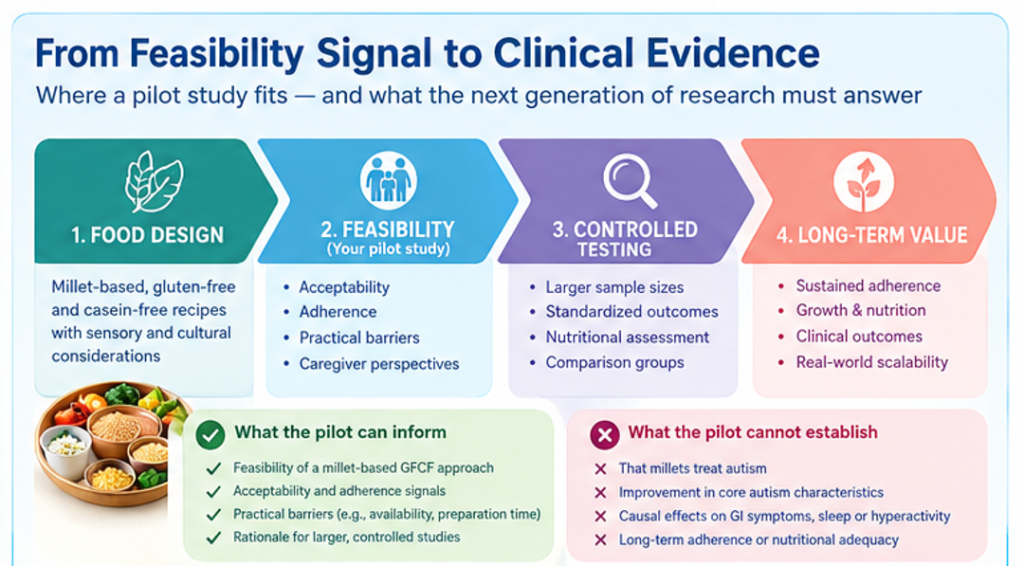
Our recent 12-week pilot study provides a practical example of why this broader framework matters. Children aged 4–6 years with confirmed ASD received a millet-based GFCF dietary intervention using foxtail, little and pearl millet developed into three recipe formats. The study assessed dietary intake, sensory acceptability, caregiver-reported adherence and feasibility. The recipes were well accepted, reported adherence was 80%, and changes were observed in dietary intake. Caregivers also reported changes in gastrointestinal comfort, sleep and hyperactivity. Ingredient availability and preparation time emerged as practical barriers. These findings are useful primarily as feasibility signals. They show that a millet-based GFCF food strategy can be implemented and studied in a real-world setting. They do not establish that millets treat autism, that the intervention changes core autistic characteristics, or that caregiver-reported changes were caused by the diet. The single-arm design, short duration and reliance on caregiver-reported outcomes limit causal interpretation.
The more important lesson is methodological. Acceptability should be measured alongside nutritional intake. Adherence should be interpreted alongside household workload. Dietary outcomes should be distinguished from clinical outcomes. Caregiver observations should generate hypotheses that can subsequently be tested using objective and validated measures.
A new research question: for whom, under what conditions, and compared with what?
The next generation of dietary research in autism should move beyond the question of whether a named diet is effective in general. More informative questions are: Which children are most likely to accept a particular food strategy? Does baseline food selectivity influence implementation? Do sensory characteristics predict adherence? How do cost, ingredient availability and preparation time affect sustained use? What happens to growth, micronutrient status and dietary diversity over longer periods?
Controlled trials should separate nutritional outcomes from autism-specific outcomes. Measures of gastrointestinal symptoms, sleep, adaptive behaviour and quality of life can be studied alongside standardized developmental or behavioural measures, while dietary intake and nutritional biomarkers provide evidence about adequacy. Longer follow-up is essential because a strategy that works for twelve weeks may not remain feasible for a year. This approach also argues for multidisciplinary research. Pediatricians, dietitians, food scientists, occupational therapists, psychologists and caregivers contribute different pieces of the same problem. Food formulation and sensory science may be as relevant to adherence as the nutrient composition of the ingredient itself.
Where the field could go next
We propose a simple progression: restriction → replacement → reconstruction → sustainability → controlled evaluation. Millets may occupy an interesting place within this pathway, particularly in settings where traditional grains are familiar and accessible. But the broader principle is more important than the ingredient.
Dietary care in autism should not be reduced to finding a “special diet.” The more constructive goal is to create food environments that are nutritionally adequate, sensory-compatible, culturally meaningful and realistic for families. Our pilot provides one example of how this can be explored; our earlier work provides a nutritional and food-science foundation; and the remaining evidence gap points toward the need for controlled, longer-term studies.
The future of dietary support may therefore depend less on what science asks families to remove and more on what it helps them put back on the table.