It is well accepted that learning medicine should be challenging since it is a difficult subject. Students must learn to make decisions under uncertainty, receive uncomfortable feedback, confront illness and death, acknowledge their limitations, and sometimes continue functioning when circumstances are far from ideal. These experiences demand resilience. But somewhere along the way, medical education has occasionally confused difficulty with harshness, challenge with humiliation, and resilience with endurance. Many educators were themselves trained in environments where public questioning, ridicule after an incorrect answer, intimidating ward rounds, or the instruction to simply “toughen up” were considered legitimate ways of producing competent doctors. Those who survived such systems may understandably believe that adversity made them stronger. The question for contemporary medical education is not whether future doctors need resilience. They unquestionably do. The more important question is: what should we ask them to become- resilient or capable of enduring difficult situation?
“Insights from medical educators emphasize that building resilience requires addressing systemic factors rather than treating it merely as an individual responsibility.”
When Resilience Becomes Endurance
Resilience is generally understood as the capacity to adapt, recover, and continue to function when confronted by difficulty. In medicine, this capacity matters. A doctor cannot expect a professional life without uncertainty, failure, emotionally demanding encounters, difficult decisions, or unexpected outcomes. However, there is an important distinction between the inherent adversity of medical practice and the manufactured adversity of medical training. A critically ill patient is inherent adversity. Being humiliated for failing to recall an obscure fact is manufactured adversity. Receiving corrective feedback is necessary. Being publicly ridiculed while receiving it is not.
Managing uncertainty is a professional capability. Learning to remain silent when treated disrespectfully should never become one. When these very different experiences are placed under the same umbrella of “building resilience,” responsibility subtly shifts from the educational environment to the learner. Instead of asking, Why does this learning environment repeatedly cause distress?, we ask, Why is this learner not resilient enough? That is a dangerous inversion. Recent syntheses of the hidden curriculum continue to identify hierarchy, mistreatment, stress, and incongruence between formally taught values and observed behaviour as important negative influences on learners
Learners observe not only what educators teach but how senior professionals use authority, respond to mistakes, speak about colleagues, and treat those lower in the hierarchy. Recent syntheses of the hidden curriculum continue to identify hierarchy, mistreatment, stress, and incongruence between formally taught values and observed behaviour as important negative influences on learners. Studies investigating medical student mistreatment highlight its significant negative impact on learners and their career trajectories The lesson absorbed may therefore be very different from the lesson intended.An institution may formally teach empathy while informally rewarding emotional detachment. It may teach respectful communication while permitting humiliation during clinical teaching. It may encourage students to report unsafe behaviour while simultaneously demonstrating that challenging authority carries consequences. Resilience cannot repair such contradictions.
Productive Discomfort Without Psychological Harm
Removing humiliation does not mean removing challenge. This distinction matters because calls for psychologically safe learning environments are sometimes interpreted as demands for easier education. They are not. Medical students should encounter difficult questions. They should be required to defend clinical reasoning, identify gaps in knowledge, practise under observation, receive corrective feedback, and experience progressively increasing responsibility. Education without intellectual discomfort would prepare them poorly for clinical practice.The challenge is to create productive discomfort without destructive humiliation.
Consider a learner who gives an incorrect answer during a clinical discussion.
One teacher responds:“You don’t know this? How did you reach final year?”
Another responds:“That conclusion worries me. Take me through your reasoning and let’s identify where it went wrong.”
Both teachers challenge the learner. Both identify inadequate performance. Both may create discomfort. But one preserves dignity and that turns the erroe into learning. This provides psychological safety. Learners are comfortable in exposing uncertainty, and acknowledging mistakes. They feel free to ask questions, and seek assistance without unnecessary interpersonal humiliation. This ensures more rigorous education. Psychological safety should be misinterpreted to be freedom from criticism and accuntability. It rovides the learner safe environment to be able to admit his mistakes and be accountable for his actions. THis behaviour is transparent and more valuable for patient care,
From Resilient Learners to Resilient Learning Systems
The next evolution in medical education should therefore move resilience beyond the individual. Insights from medical educators emphasize that building resilience requires addressing systemic factors rather than treating it merely as an individual responsibility. For years, institutions have offered learners stress-management sessions, mindfulness programmes, wellness activities, counselling, and resilience workshops. These interventions can be valuable. But they become problematic when they are used to compensate for environments that remain unnecessarily harmful. Repeatedly exposing clinicians to an avoidable occupational hazard and then definong safety primarily as improving their capacity to withstand it is not the right way of training. Educational environments deserve the same systems thinking.
A resilient learning system would distribute responsibility across three levels- the learner, the educator and the institution. At the learner level, we should develop adaptive coping, reflective capacity, emotional regulation, help-seeking, tolerance of uncertainty, and the ability to recover from setbacks. Faculty should be trained through structired developmenalt activities that should include teaching techniques as well as responsible use of power, so that the trainers are equipped with the skill of challenging learners in workplace without ridiculing them. They should be able to provide feedback by maintaining identity and distinguish lack of conpetence from lack of confidence. Educators should also recognize incidents when traditional teaching methods create harmful behaviour and unsafe environment.
Finally, at the institutional level, medical schools should develop systems to identify teaching with humiliation by certain teachers. Addressing those mechanisms need to be incotporated into the system. Apart from reporting such events, additional factors like leadership behaviour, faculty role-modelling, responses to complaints, workloads, assessment practices, hierarchy, and informal norms need to be considered to determine what the acceptable situation by learners. Collectively these can transform the cuture. The important opportunity of resilience education becoming a bridge between learner development and organisational responsibility can be created.
Future perspective: resilience for medicine, not resilience against medical education
The future doctor will arguably require greater resilience than previous generations. Healthcare systems are becoming more complex. Artificial intelligence will continually reshape professional roles. Information overload, uncertainty, changing patient expectations, resource constraints, ethical dilemmas, and rapid technological change will demand extraordinary adaptability. Because the future contains so much unavoidable uncertainty, educators should question the value of adding avoidable adversity.
The goal should not be to produce doctors who can tolerate humiliation. It should be to produce doctors who can remain thoughtful during uncertainty, recover constructively from failure, speak when something is unsafe, seek help without shame, challenge inappropriate authority, and continue to treat others humanely under pressure.
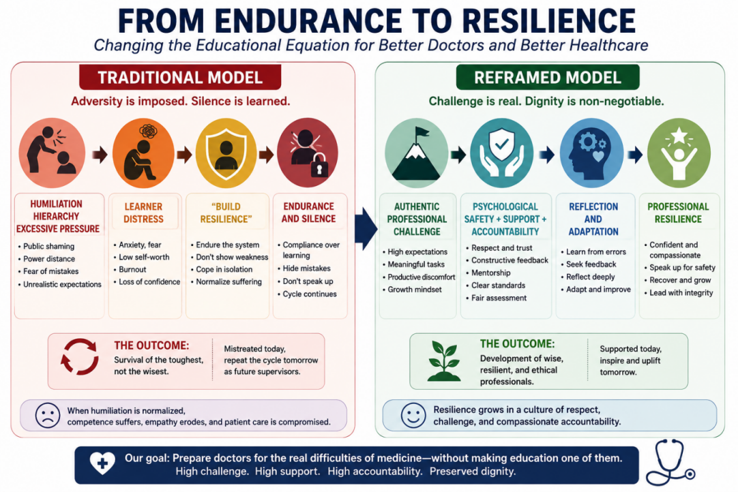
This requires a different educational equation: (Figure 1)
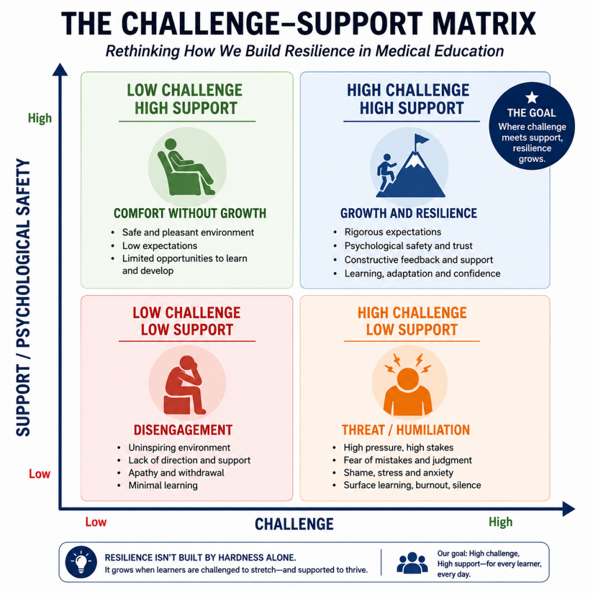
High challenge + high support + high accountability + preserved dignity = meaningful resilience.
Such an approach does not weaken medical education. It makes its expectations clearer. Perhaps the most important test is to consider what happens when today’s learner becomes tomorrow’s teacher. A learner repeatedly taught that humiliation creates excellence may eventually reproduce the same behaviour while believing it to be educationally justified. In this way, mistreatment can become self-perpetuating: I endured it, therefore you should endure it.
A learner who instead experiences rigorous questioning, respectful correction, psychological safety, reflective dialogue, and compassionate accountability encounters a different professional model: I was challenged without being diminished; therefore I can challenge others without diminishing them. That may be one of the most important forms of resilience medical education can cultivate. The question, then, is not whether medical education should make learners tougher. It is whether we can prepare them for the genuine difficulties of medicine without becoming one of those difficulties ourselves. (Figure 2)