Creating synthetic life from scratch is a long-standing scientific goal that could help understanding origins of life and also advance drug discovery, bioremediation, and materials science. A key feature of living systems is compartmentalization, which allows biochemical reactions to occur in organized and controlled environments. In cells, compartments can be membrane-bound organelles or membrane-less organelles, which form through a process called liquid–liquid phase separation (LLPS). These biomolecular condensates help organize cellular reactions and regulate processes such as information storage and signaling. Many condensates also contain multiple internal phases, allowing different biological activities to occur in different parts of the same compartment. Understanding how these dynamic structures form and function can provide important principles for designing synthetic cells and artificial biological systems.
The important roles of intracellular condensates have inspired the development of synthetic condensates that mimic key features of cellular compartments. Their composition, size, structure, viscosity, and fluidity can be controlled by adjusting molecular interactions, while responsive components can enable them to form, change or dissolve in response to environmental signals. These properties make synthetic condensates useful for studying biological phase separation and developing dynamic, life-like systems. They can selectively concentrate molecules and act as small reaction compartments, potentially improving chemical reactions. Their ability to respond to biological, chemical, and physical signals also creates opportunities in biotechnology, biomedicine, and materials science, while providing simplified models for understanding cellular organization and early life.
In our recent work published in Advanced Materials (Adv. Mater. 2026, 38, e73940), we designed short peptides inspired by a minimal sticker-and-spacer model that best represents the intrinsically disordered proteins and regions (IDPs/IDRs) which form biomolecular condensates in living cells. These peptides formed synthetic condensates that mimic key features of cellular condensates, including spatial organization and structural compartmentalization. This study demonstrated how minimal peptide sequences can encode emergent organizational principles characteristic of biomolecular condensates.
“Our work presents a simple strategy for constructing complex, cell-like architectures under laboratory conditions that mimic key features of living systems.”
Life-Like Behaviors
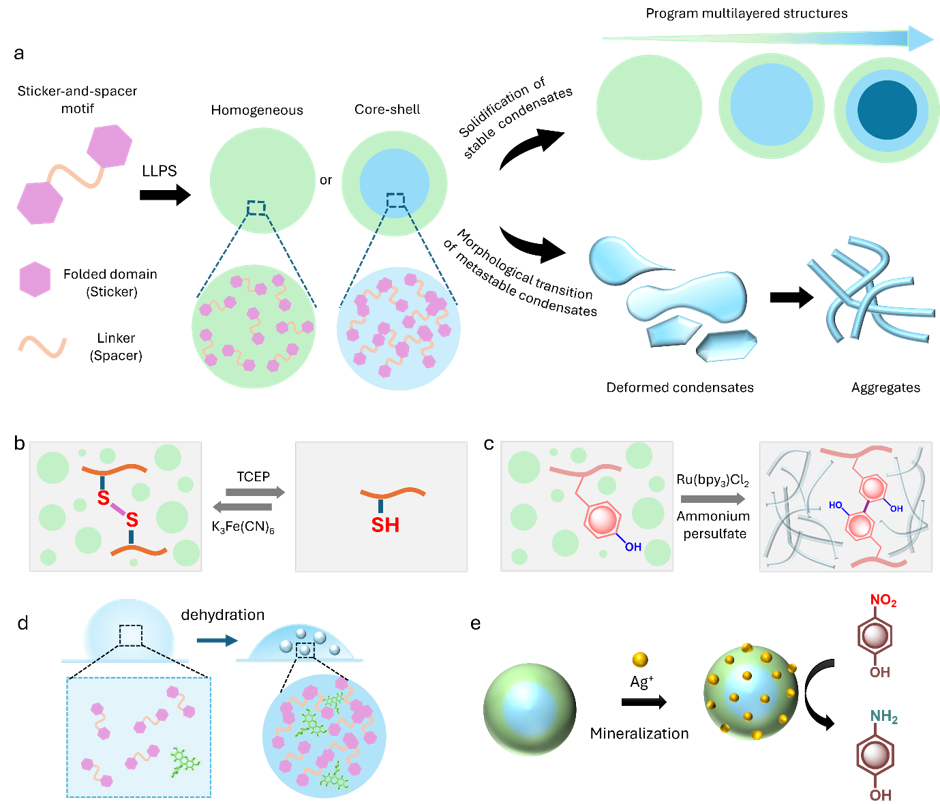
Similar to intracellular liquid–liquid phase separation (LLPS), the designed peptides underwent self-association through multiple weak, non-covalent interactions, including π–π stacking, hydrophobic interactions, cation–π interactions, and hydrogen bonding. When the peptide concentration reached a critical threshold, these cumulative interactions promoted phase separation of the initially homogeneous solution into two distinct phases: a highly concentrated condensed phase and a surrounding dilute phase. This process resulted in the formation of macroscopically observable coacervate-based liquid droplets. Initially, a large number of small condensates, approximately 300 nm in size, were formed. Over time, these droplets underwent coalescence, resulting in the formation of larger condensates, similar to the fusion, mimicking the chemically transduced process found in cell. Subtle modifications to the peptide molecular design could modulate the interactions and alter the size, morphology, dynamics, and material properties of the resulting condensates.
Multiphasic structure of Synthetic Biomolecular Condensates
Many cellular organelles, such as nucleoli and stress granules, are multiphasic containing distinct regions within a single compartment. Most synthetic multiphasic coacervates are constructed from multiple building blocks, such as proteins, polymers, and nucleic acids, often relying on strong ionic interactions. In contrast, we demonstrated that complex multiphasic condensates can be formed using a single peptide building block. By tuning interactions within the peptide’s sticker and spacer regions, we were able to control the condensate architecture from homogeneous to core–shell and multiphase structures. Single-crystal structural analysis provided insights into the molecular interactions responsible for forming these distinct regions. In core–shell structures, stronger peptide–peptide interactions could promote an ordered, solid-like core, while weaker interactions and greater peptide–water interactions could support a more disordered shell. By controlling the number and strength of interactions between sticker and spacer regions, the number and arrangement of phases could be tuned. This approach therefore provides a simple strategy for controlling the structure and spatial organization of synthetic condensates. Such precise spatial organization could help compartmentalize biomolecules, regulate biochemical reactions, and enable the design of complex reaction networks for biotechnology.
Dynamic Control
Biomolecular condensates can dynamically assemble and disassemble in response to environmental changes and biochemical signals, allowing cells to regulate their functions. Inspired by this behavior, we developed redox-responsive peptide condensates that reversibly formed and dissolved in response to changes in the oxidation state. The designed peptides contained a disulfide linker that enabled redox-controlled phase separation. Treatment with tris(2-carboxyethyl)phosphine (TCEP) reduced the disulfide bonds, disrupting peptide interactions and dissolving the condensates. Conversely, potassium ferricyanide (K₃Fe(CN)₆) promoted disulfide-bond formation, restoring the condensates. This process could be repeated over multiple cycles, demonstrating reversible and dynamic control of condensate formation. Such redox-responsive coacervates provide a simple model for studying how redox processes regulate biomolecular organization in cells and offer opportunities for developing adaptive materials and biotechnology applications.
Artificial Condensates as Catalytic Microreactors
Inspired by the nature’s principle, synthetic coacervates can be designed as catalytic compartments that mimic the functional features of biological systems. We investigated whether our peptide condensates could selectively sequester molecules with different chemical properties. We found that the condensates efficiently encapsulated positively charged, hydrophobic, and negatively charged guest molecules which were likely concentrated through π–π, hydrophobic, and charge-dependent interactions with the peptides. The ability to concentrate diverse molecules within the condensates suggested their potential as microreactors. To test this, we used the non-enzymatic hydrazone formation reaction between an aldehyde and a hydrazine. The reaction proceeded significantly faster in the presence of the peptide condensates, demonstrating their ability to create a favorable microenvironment for chemical reactions. These results highlight the potential of peptide-based condensates as biocompatible and environmentally friendly catalytic microreactors.
Solidification of Peptide Condensates and Biomineralization
Conventional LLPS in bulk often produces droplets that rapidly fuse and coalesce, making long-term stabilization challenging. Designing condensates that resist coalescence is therefore important for maintaining small, distinct droplets with functional properties over extended periods. We found that our peptide condensates remained stable in solution for extended periods and can solidify upon solvent evaporation, forming stable peptide microparticles. These particles could encapsulate and protect molecular cargo during drying, providing a simple strategy for molecular storage and protection, similar to the protective strategies of biological condensates during desiccation. Furthermore, the solidified peptide particles could function as artificial bioreactors and support biomineralization, enabling the formation of metal–peptide hybrid materials. Such materials have potential applications in catalysis, environmental remediation, biomedicine, and other industrial fields.
Challenges Towards Synthetic Biomolecular Condensates
Despite significant progress in designing synthetic biomolecular condensates with life-like properties, several major challenges remain. Synthetic condensates can be unstable and may merge easily, while their complex compositions can make them difficult to control and reproduce. Key properties such as stability, composition, selective permeability, functionality, scalability, and reproducibility have not been properly established yet. Moreover, the structure-dynamics-functions relationship remain unclear for these designed biomolecular condensates. Understanding these phenomena will be essential for developing reliable biomimetic systems and exploring their potential applications in artificial cells and advanced materials.
Future perspective
Synthetic condensates share several important features with biological condensates found inside cells. Their dynamic nature, ability to create cell-like compartments, and tunable properties make them useful for studying molecular interactions and biological processes in controlled artificial environments. These droplets can also act as versatile carriers for a wide range of molecules, including drugs, proteins, enzymes, RNA, catalysts, and nanoparticles that could enable new approaches for targeted and combination delivery. Furthermore, coacervates can reversibly form and respond to changes in different stimuli like pH, temperature, or biological signals. By controlling these properties through molecular design, synthetic coacervates can be developed as adaptable platforms for applications in biotechnology, biomedicine, artificial cells, and advanced functional materials.