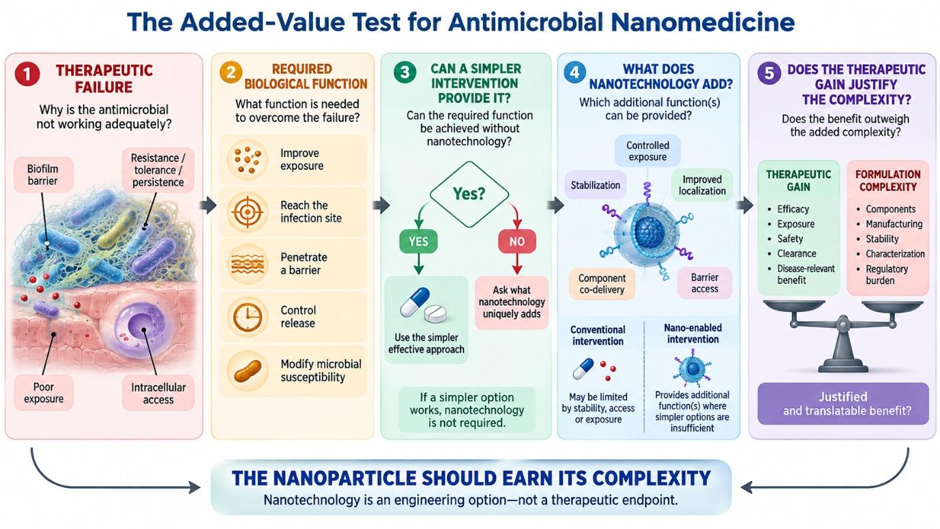
Start with the failure, not the material
For decades, antimicrobial development has often been framed around a deceptively simple question: how can we kill the pathogen? The harder translational question is why an antimicrobial that works under controlled laboratory conditions sometimes fails in the biological environment where treatment actually occurs.
Resistance is only part of the answer. Resistance, tolerance and persistence are biologically distinct, yet all can contribute to treatment failure. Drug exposure may be inadequate at the infection site; biofilms may restrict access; intracellular reservoirs may limit antimicrobial exposure; and toxicity may constrain effective dosing. These problems shift the challenge from simply finding a more potent antimicrobial to overcoming the conditions that prevent an existing antimicrobial from working.
Nanomedicine provides powerful tools for modifying stability, release, localization, exposure and interactions at microbial or host interfaces. Recent work has increasingly linked nanomaterial design to defined infection barriers and disease-relevant outcomes rather than to material classes alone. Yet this progress raises a more fundamental question: when does adding a nanoparticle constitute a therapeutic advance rather than simply a more elaborate formulation?
The starting hypothesis should therefore be the therapeutic failure-not the nanoparticle. A rational antimicrobial nanomedicine should begin by identifying what prevents an otherwise useful antimicrobial from achieving its intended effect. If poor solubility limits exposure, a delivery system may be justified. If rapid degradation reduces effective concentration, controlled release may provide a meaningful function. If a biofilm limits access, improved penetration or barrier disruption may matter. If intracellular localization is the limitation, nanoscale trafficking may offer an advantage that conventional administration cannot readily achieve.
But one question should come before formulation design: Can the required function be achieved through a simpler intervention? If yes, the nanoformulation should demonstrate an additional benefit. If no, the next question is what nanotechnology uniquely contributes and whether that contribution can be demonstrated. This suggests a simple counterfactual: What therapeutic function disappears when the nanoparticle is removed? This is not a new assay. It is a way of interpreting evidence. A lower minimum inhibitory concentration can demonstrate improved in-vitro activity, but it does not by itself establish therapeutic added value. A stronger case exists when removing the nanomaterial also removes a demonstrated advantage in exposure, localization, barrier access, toxicity, bacterial clearance or another meaningful therapeutic outcome.
Added antibacterial activity is therefore not necessarily added therapeutic value. The relevant comparison is not simply “nano versus no nano”. It is whether the nanoformulation provides a benefit that a simpler intervention cannot provide with comparable effectiveness, safety and feasibility.
Make the added function earn its evidence
The field is increasingly moving toward mechanism-linked and disease-relevant evaluation of antimicrobial nanomedicine. Recent work has connected nanomaterial strategies with biological barriers, quantitative outcomes and translational considerations beyond the in-vitro minimum inhibitory concentration. The important question now is not simply what can nanotechnology do? but what does it add that matters therapeutically?
That added value can be considered at three levels. First, biological value: does the nanomaterial perform a defined function, and has that function actually been demonstrated? Second, therapeutic value: does that function improve an outcome beyond a simplified laboratory measurement? Third, translational value: does the benefit remain meaningful after accounting for stability, safety, reproducibility, manufacturing, dosing and regulatory requirements?
This creates an evidence ladder:
Activity is not mechanism; mechanism is not resensitization; resensitization is not clinical efficacy; and clinical efficacy alone does not guarantee translation.
This distinction is particularly important when discussing resistance modification. A reduction in the antimicrobial concentration required to inhibit a resistant isolate demonstrates altered susceptibility; it does not, by itself, establish reversal of the underlying resistance mechanism.
Our recent work illustrates why this distinction matters. A plant-volatile nanoemulsion altered the susceptibility of benzalkonium-chloride-resistant Pseudomonas aeruginosa to benzalkonium chloride, with evidence of increased membrane permeability, biofilm activity and enhanced performance in an ex-vivo porcine-skin model. Because benzalkonium chloride is a quaternary ammonium biocide rather than a conventional therapeutic antibiotic, these findings should be interpreted as a proof of concept for resistance-modifying antimicrobial design, rather than evidence of clinical antibiotic resensitization. The broader lesson is simple: the formulation should be judged by the function it adds, not merely by the magnitude of the numerical improvement it produces.
Natural products expose the same problem
Natural products provide a useful test case because their chemical complexity can contain multiple biological activities. Membrane perturbation, efflux modulation, biofilm interference and altered cellular permeability may modify antimicrobial susceptibility or improve antimicrobial access. But chemical complexity must become functional definition. The translational question should therefore move from “what does this extract do?” to “which defined function within it changes the therapeutic response, and can that function be reproduced?”
Nanotechnology may help by stabilizing labile constituents, improving dispersion, controlling exposure or bringing complementary components into proximity at a relevant biological interface. But the same test applies: if the free compound or extract already provides the required function with comparable benefit, nanosizing alone does not establish therapeutic necessity.
This distinction matters because natural-product nanomedicine is itself becoming a crowded field. The opportunity is therefore not to add another catalogue of natural-product nanoformulations, but to determine what the nanoarchitecture contributes beyond the natural product itself. Natural origin should likewise never be treated as a surrogate for safety or efficacy. Composition, dose, reproducibility, host exposure and mechanism remain essential.
Make complexity earn its place
Nanomedicine can add functions to antimicrobial therapy, but every added function can also add complexity. A second active component may introduce a new interaction. A targeting ligand may create additional manufacturing and characterization requirements. A sophisticated release mechanism may increase formulation sensitivity. A multifunctional platform may create additional questions around stability, pharmacokinetics, safety and regulatory control.
This leads to a principle of minimum effective complexity: The goal is not the simplest formulation imaginable; it is the least complexity required to deliver a demonstrated therapeutic function.
And this principle has an important corollary: As formulation complexity increases, the evidence should become stronger that each added component delivers meaningful therapeutic value.
A simple nanoformulation that solves a genuine exposure problem may therefore be more compelling than a highly multifunctional platform whose individual contributions cannot be separated.
Translation must also consider evolutionary consequences. Altered antimicrobial exposure can change the selective environment experienced by microbial populations, making dose, duration and exposure profiles relevant to stewardship as well as efficacy.
The objective, therefore, is not to make antimicrobial nanomedicine increasingly complicated. It is to make it increasingly justified. Nanotechnology should be treated as an engineering option, not a therapeutic endpoint. The nanoparticle should not be the starting hypothesis; the therapeutic failure should be. The central question is not simply whether nanotechnology can make an antimicrobial work better, but what it makes possible that simpler therapy cannot-and whether that gain is worth the complexity.