What India’s Research Grants Reveal
Every year, thousands of Indian researchers ask the Indian Council of Medical Research (ICMR), the country’s apex body for biomedical research, to back an idea: a low-cost diagnostic, a fresh approach to drug-resistant tuberculosis, a sensor that could work in a village clinic. Only a fraction are funded. The approved lists are public, yet they are rarely read as a whole. Read together, they show how a nation decides which health problems to tackle, who gets to tackle them, and where the answers are likely to come from.
Funding debates usually focus on total budgets. Who receives the support, and for what, matters just as much. We therefore analysed all 1,766 projects approved under ICMR’s Small and Intermediate Grant schemes between 2023 and 2025, recording each project’s institution, its type and location, and its research theme.
“India’s health research is becoming a partnership between doctors and engineers, and the boundary between medical and technical science is fast disappearing.”
Progress: medicine and engineering are converging
The clearest trend is a change in who is doing health research. In 2023, about 35% of approved projects came from non-medical institutions such as the IITs, the Indian Institute of Science, NITs, CSIR laboratories, and universities. By 2025 that share had risen to 42%. Engineering institutes were the largest group among them, accounting for nearly half of all non-medical projects, with work on medical devices, biosensors, microfluidics, robotics, and AI-based diagnostics. IIT Delhi and IIT Madras, for example, frequently appear as recipients for projects on microfluidics, biosensors, and AI diagnostic tools. The rise peaked in 2025, possibly because the latest call for proposals stressed indigenous device development and digital health.
Small Grants, meant for early-stage and high-risk ideas, appear to be doing what they were designed to do. They let engineers build prototypes that clinicians can then test with patients. This matters for a country that imports much of its medical technology. A device designed in India, for Indian conditions and budgets, is far more likely to reach the patients who need it.
There is also a sign of a working pipeline. Investigators who deliver on a Small Grant are often funded again, under an Intermediate Grant, to scale up their findings. And the split between government institutions (about 69% of projects) and private or trust-run institutions (about 31%) barely moved across the three years, which hints at a settled, deliberate approach to allocation. Private centres such as CMC Vellore are clearly part of the national research effort.
Priorities: the burden of disease shapes the portfolio
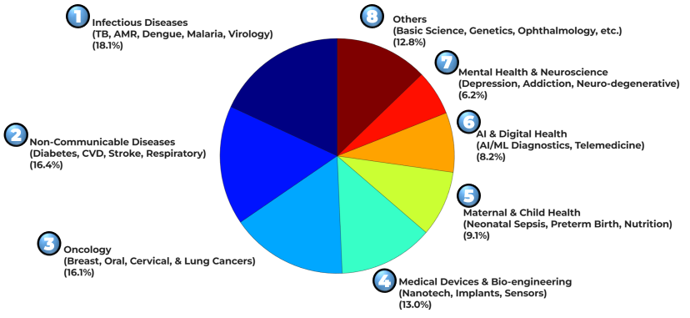
Funding largely follows the country’s health needs. Infectious diseases (18%), non-communicable diseases such as diabetes and stroke (16%), and cancer (16%) together account for just over half of all projects. India carries all three burdens at once, and the portfolio reflects it. Tuberculosis is the single most funded disease, with projects ranging from drug resistance to host-directed therapies. Maternal and child health (9%) and mental health (6%) also appear as distinct themes (Figure 2).
Technology-focused work is growing alongside them. Bio-engineering and AI or digital health together make up about one in five projects, a large share for fields that barely featured in health research funding a decade ago.
Gaps: concentration, geography, and the missing middle
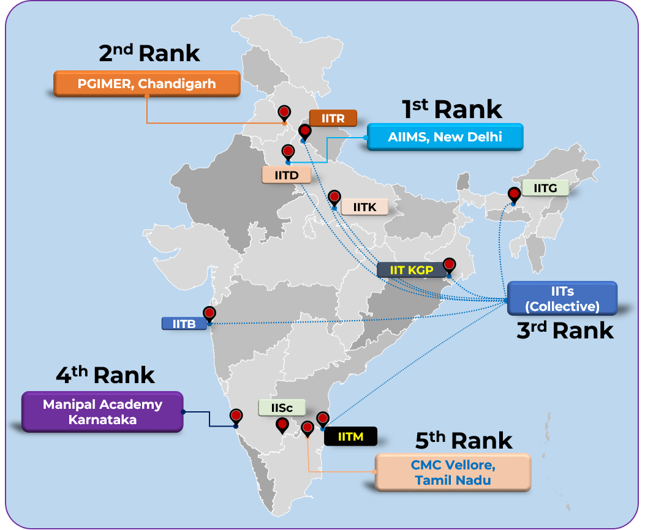
The same lists show where the system is uneven. The top seven institutions received roughly 35% of all approved projects, led by AIIMS New Delhi (about 13%) and PGIMER Chandigarh (about 6%). Concentrating resources where capacity exists is understandable, but funding follows track record and track record follows funding, so institutions that start ahead tend to stay ahead. Figure 1 maps the leading recipients, from AIIMS New Delhi and PGIMER Chandigarh in the north to the IITs spread across the country and CMC Vellore in the south.
Geography tells a similar story. Northern India received 38% of projects and Southern India 32%. Western India received about 15%, Eastern India under 10%, and Central and North-East India together only 5%. Delhi and the National Capital Region alone accounted for nearly a fifth of the total. Meanwhile, state medical colleges and state universities, which see large patient numbers and could ask locally relevant questions, appear far less often in the funded lists. There are encouraging signs at the margins, with AIIMS Bhopal, AIIMS Guwahati, IIT Guwahati, and the research hubs of Kolkata and Bhubaneswar all showing up in the lists, but the volume there remains small. A small group of investigators also won more than one award in a single year. That may reflect proven expertise, but it raises a fair question about how widely opportunity is spread. The concern is practical as well as fair. Disease burden is not concentrated in the same places as research infrastructure, and the questions that matter most to a patient in a district hospital are best asked by people who work alongside that patient.
Reading the Numbers with Care
Our contribution is to make these patterns visible. We counted approved projects, not rupees, so our figures show how projects are distributed rather than how much money each group received. We also had no data on unsuccessful applications, so we cannot say who applies and fails. Themes were assigned from project titles, which is an approximation. Even so, three years of consistent patterns are hard to dismiss. They describe a system that is modernising quickly and that still leans on a small number of well-established centres, and that is the starting point for any serious conversation about where the next rupee should go.
The Way Forward: Widening Research Opportunities
India’s biomedical research funding is moving in a healthy direction. It is more technological, more collaborative across disciplines, and broadly matched to the country’s disease burden. The next challenge is reach. First, we should invest in research capacity, not only projects, through mentoring, proposal-writing support, and shared laboratories for colleges that rarely appear in the lists. Second, we should pair strong and emerging institutions so that local clinical questions shape technology-driven work. Third, funders should publish applicant numbers, success rates, and amounts by institution type and region. Finally, we should follow projects through to their outcomes, since counting grants does not tell us whether they produced better care. A research system is strongest when good ideas can come from anywhere, whether an IIT laboratory in Delhi or a district hospital in Odisha. Funding the best of what already exists is necessary. Building the capacity that lets more people compete will make the system fairer and more productive.