
The Rise of mRNA Vaccines
Vaccination remains inevitable in modern medicine, having prevented millions of deaths and significantly reduced the burden of infectious diseases worldwide. The vaccine technology has evolved from the early development of live-attenuated and inactivated vaccines to the introduction of recombinant protein and viral vector platforms to address emerging public health challenges (Figure 1). Today, the remarkable success of messenger RNA (mRNA) vaccines, which were recently introduced, marks a new era in vaccinology (Figure 1), demonstrating unprecedented speed, flexibility, and efficacy in responding to global health emergencies.

“We are witnessing a paradigm shift in vaccine development.”
The COVID-19 pandemic, although chaotic, highlighted the potential of mRNA technology as a rapid-response platform capable of accelerating vaccine development from sequence identification to clinical deployment within months Unlike conventional vaccines, which require pathogen propagation or large-scale protein production and/or adjuvant combinations, mRNA vaccines leverage the body’s own cellular machinery to produce target antigens, enabling a highly adaptable and scalable manufacturing process. This platform not only shortens development timelines but also offers significant opportunities for addressing emerging infectious diseases (pandemic preparedness), seasonal pathogens, and even non-infectious conditions such as cancer. That being said, the mRNA is highly unstable and requires delivery technology to succeed. Lipid nanoparticles (LNPs) have emerged as the gold-standard delivery system, protecting fragile mRNA molecules from degradation while facilitating efficient cellular uptake and antigen expression. Continuous improvements in LNP composition, tissue targeting, and safety profiles are expected to further enhance vaccine performance. Unlike conventional vaccines, which often require separate adjuvants, mRNA–lipid nanoparticle (mRNA-LNP) vaccines possess intrinsic adjuvant properties. The LNP carrier (based on its composition) can stimulate innate immune pathways, leading to the production of cytokines and chemokines that enhance antigen presentation and adaptive immune responses. The LNP components, particularly ionizable lipids, promote the recruitment and activation of antigen-presenting cells such as dendritic cells, facilitating robust T-cell and antibody responses. However, the level of innate immune activation must be carefully balanced. Excessive stimulation can reduce mRNA translation, increase reactogenicity, and compromise vaccine efficacy. Conversely, controlled immune activation serves as a self-adjuvanting mechanism, eliminating the need for additional adjuvants in many mRNA vaccine formulations. This property has been a key contributor to the success of mRNA-LNP vaccines against infectious diseases, including COVID-19. Ongoing research aims to optimize lipid composition and mRNA design to fine-tune adjuvant activity, thereby maximizing immunogenicity while minimizing adverse effects. The ability to precisely modulate innate and adaptive immune responses remains one of the major advantages of the mRNA-LNP vaccine platform.
Challenges of mRNA-LNP Technology and Strategies to Overcome
Despite these notable advances, mRNA-LNP technology platforms have several limitations. However, significant advances are rapidly overcoming many of the limitations. One of the major concerns has been the cold-chain requirements. The cold-chain requirements associated with mRNA-LNP formulations are being addressed through the development of more stable lipid compositions, improved formulation strategies, the incorporation of novel cryoprotectants and the selection of suitable storage buffers (Figure 2).
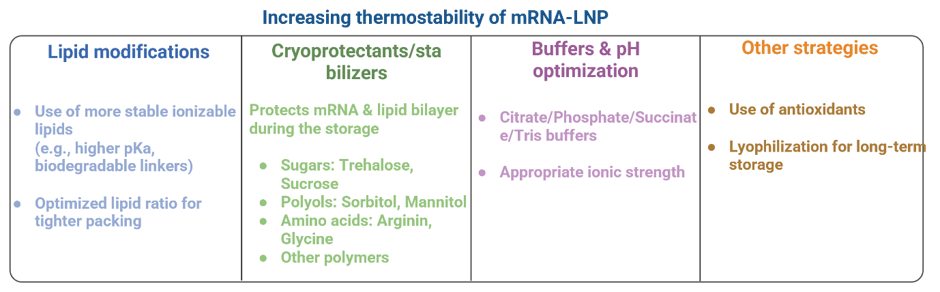
These innovations are expected to enhance product stability and facilitate global distribution. The liver tropism of conventional LNPs, which restricts delivery to other tissues, is another limitation. Emerging technologies such as Selective Organ Targeting (SORT) nanoparticles are now enabling tissue-specific delivery to organs beyond the liver, expanding the therapeutic potential of mRNA medicines. Similarly, Innate immune activation remains an intricate aspect of mRNA therapeutics. While excessive immune stimulation can compromise efficacy and safety, particularly in applications such as cell therapy and protein replacement therapy, controlled or optimal innate immune activation can serve as a powerful adjuvant effect in vaccine development, enhancing protective immune responses. Advances in manufacturing technologies, including scalable in vitro transcription processes and microfluidic-based platforms for continuous nanoparticle production, have significantly improved the feasibility of large-scale mRNA-LNP production. Moreover, the cost of key reagents, including cap analogues, polymerase enzymes, NTPs (with or without modifications), and other materials, has significantly decreased compared with prices during the COVID-19 pandemic (Figure 3).
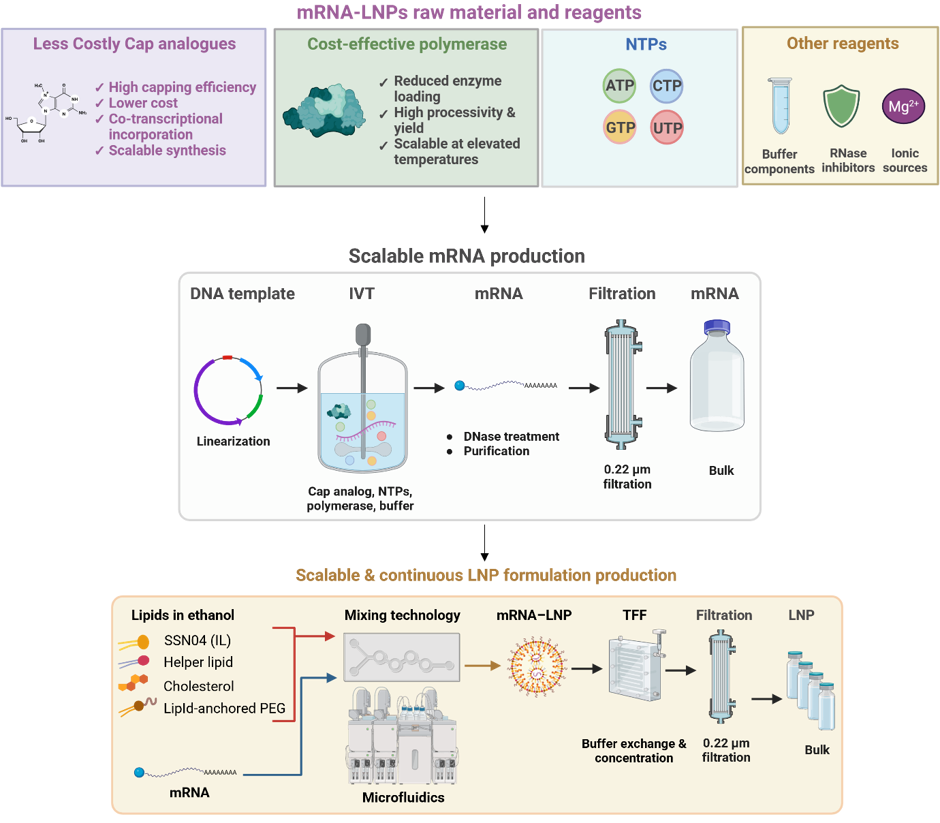
These developments have transformed mRNA therapeutics from an experimental concept into a commercially viable platform. Another critical focus area is improving endosomal escape, which remains a major bottleneck for intracellular mRNA delivery. Chemists and formulation scientists (including our group) worldwide are actively designing next-generation ionizable lipids and novel nanoparticle architectures to enhance cytoplasmic release of mRNA. Continued innovation in lipid chemistry, delivery technologies, and manufacturing platforms is expected to drive the next generation of mRNA therapeutics, broadening their applications far beyond vaccines and opening new possibilities for treating a wide range of diseases.
Future Perspectives
Looking ahead, the future of vaccines extends beyond infectious disease prevention. Personalized cancer vaccines, therapeutic vaccines for chronic diseases, and mucosal vaccines are poised to expand the boundaries of immunization science. Moreover, technology platforms are being rapidly explored for cell and gene therapies, gene editing, protein replacement therapies, biologics production, and more. The recent success of mRNA-LNP-based gene editing (NTLA-2001 [Intellia Therapeutics] and VERVE-101 and VERVE-102 [Verve Therapeutics]) in advanced preclinical and clinical trials has attracted considerable attention. In addition, other mRNA modalities, such as self-amplifying RNA platforms, circular RNA platforms, trans-amplifying RNAs, and others, are being explored for various ailments. Advances in AI/ML, systems biology, and genomic surveillance will further accelerate antigen discovery, lipid design, and vaccine optimization, enabling more proactive responses to future pandemics and emerging health threats.
“The future of vaccines is no longer limited to prevention; it is becoming a powerful platform for personalized, adaptable, and globally accessible healthcare solutions.”
Conclusion
In our opinion, we are witnessing a paradigm shift in vaccine development. The convergence of mRNA technology, advanced delivery systems such as LNPs, novel adjuvants, and precision immunology is redefining what vaccines can achieve. As scientific invention continues to accelerate, the next generation of vaccines will not only provide faster and more effective protection against infectious diseases but also open new therapeutic avenues for some of humanity’s most challenging health conditions. The future of vaccines is no longer limited to prevention; it is becoming a powerful platform for personalized, adaptable, and globally accessible healthcare solutions.