
Neuromodulation is among the fastest-growing branches of medicine in this century. Although it is often associated with flagship procedures such as deep brain stimulation (DBS), its scope extends far beyond the brain. In recent years, advances in implants and wearable technologies have made it increasingly feasible to target distant peripheral organs and modulate their function through neural pathways. This expanding field marks the emergence of electroceuticals, therapies that use electrical stimulation to influence biological function and treat disease.
“From deep brain stimulation to wearable nerve stimulators, electroceuticals are rewiring the future of care.”
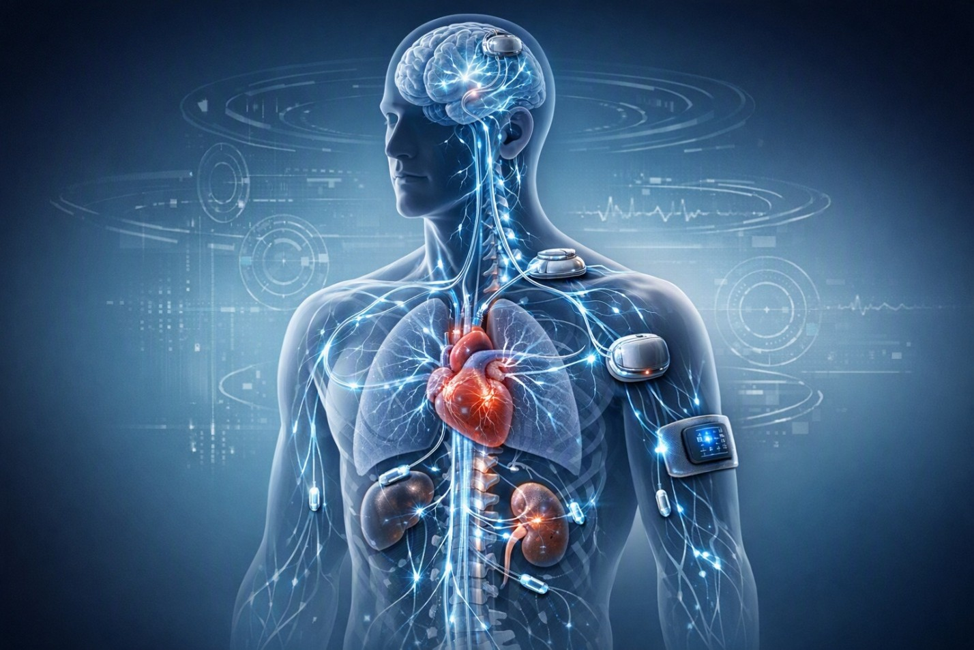
Electroceuticals are bioelectronic implants or wearable devices that stimulate the nervous system to treat disease (Figure 1). Their therapeutic effect is based on targeted stimulation of a neural node, pathway, or nerve within the central or peripheral nervous system, with the goal of modifying the output of the affected end organ.
DBS is an established therapy for Parkinson’s disease and other movement disorders. It is also being used increasingly for psychiatric disorders and pain. By stimulating specific brain nuclei, DBS can modulate the output of motor, sensory, or limbic circuits and reduce disease-related symptoms.
A similar principle applies to spinal cord stimulation (SCS) and peripheral nerve stimulation (PNS), both of which are widely used in patients with chronic pain. Functional electrical stimulation (FES) of peripheral nerves can also enhance motor activity and improve rehabilitation outcomes.
The concept of electroceuticals is now extending beyond brain disorders to a wide range of systemic conditions, including diabetes, post-traumatic stress disorder, fibromyalgia, asthma, obstructive sleep apnea, incontinence, erectile dysfunction, and acute renal dysfunction. Temporary or permanent implants that target the peripheral or autonomic nerve supply of affected organs may improve end-organ function without producing broad systemic effects.
Electrical impulses are the language of the body’s neural networks. Nearly every organ and physiological function is regulated by circuits of neurons communicating through these signals. As this understanding advances, electroceuticals are likely to play an increasingly important role in controlling and modifying both neurological and non-neurological diseases.
Brain Disorders and Electroceuticals
Over the past two decades, therapeutic brain stimulation has transformed the treatment of movement disorders. Deep brain stimulation (DBS) is now regarded as one of the most technologically advanced tools in the neurosurgical armamentarium, building on more than 50 years of clinical experience with therapeutic brain stimulation and more than a century of human brain stimulation research.
DBS acts by modulating activity within targeted neural structures. High-frequency stimulation is commonly described as producing effects such as “neuronal jamming” or “depolarization blockade,” which can reduce abnormal circuit activity and improve symptoms.
Although DBS is best established for movement disorders such as Parkinson’s disease, its use has expanded to several other neurological and neuropsychiatric conditions, including psychiatric disorders, chronic pain, cognitive disorders, epilepsy, and addiction.
Other Implanted Neuromodulation Therapies
DBS is not the only invasive electroceutical therapy in current use. Other implanted neuromodulation approaches include motor cortex stimulation (MCS) for chronic pain, spinal cord stimulation (SCS) for pain and, increasingly, for selected cases of paraplegia, peripheral nerve stimulation (PNS) for migraine and chronic focal pain, vagus nerve stimulation (VNS) for epilepsy and other disorders, and responsive neurostimulation (RNS) for epilepsy.
Wearable and Noninvasive Stimulation
In addition to implanted devices, wearable and noninvasive stimulators are becoming increasingly common. Commercially available examples include head-worn stimulators for headache and migraine, wearable vagus nerve stimulators for anxiety and insomnia, and external stimulators for back pain or peripheral nerve pain in the hands and legs. Functional electrical stimulation (FES) has also been adapted into wearable bands and external systems designed to support motor activation and rehabilitation.
Electroceuticals Beyond the Brain
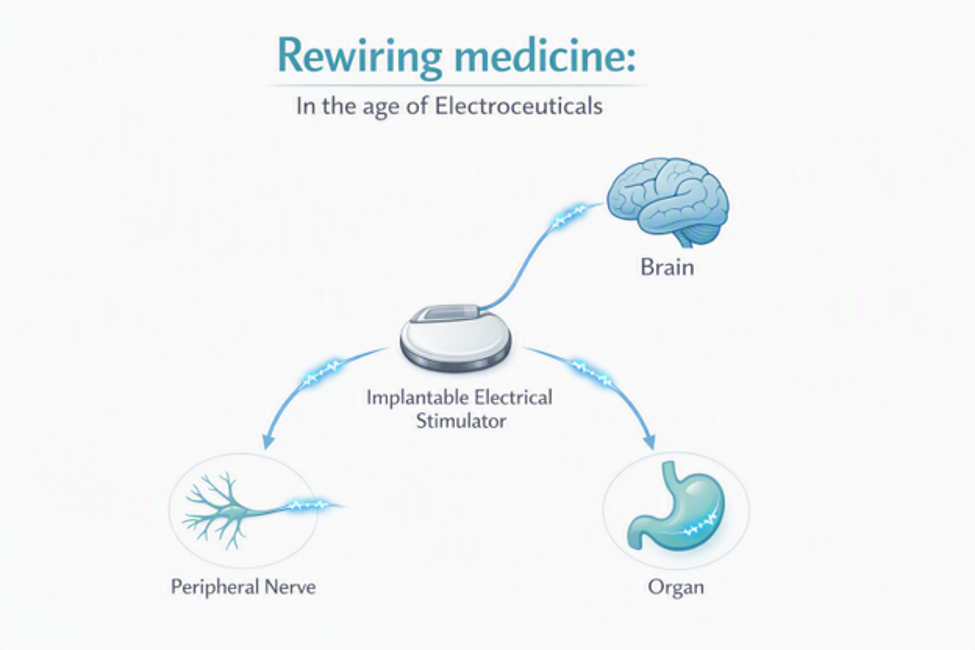
Electrical modulation is no longer limited to the brain; it is increasingly being explored for the functional regulation of other organs (Figure 2). Hypoglossal stimulation for obstructive sleep apnea (OSA) is now commercially available. Wearable posterior tibial nerve stimulators have been used for stress incontinence, while tracheal implants that selectively stimulate the sympathetic plexus in the tracheal wall have been proposed to help abort acute asthma attacks. Neck-worn stimulators targeting the carotid sinus and renal artery-stimulating stents have both been investigated for hypertension. Other potential applications include wearable stimulation for erectile dysfunction and dysmenorrhea, modulation of hepatic vessel tone in portal hypertension, and immune regulation through sympathetic stimulation. In peripheral vascular disease and unstable angina, electrical stimulation has also shown promising therapeutic potential.
The Future of Electroceuticals
In the near future, treatment for many common conditions may shift from taking a pill to using targeted wearable stimulation. Instead of relying solely on medication for a headache or abdominal pain, a patient may simply place a wearable stimulator over the head or abdomen to deliver localized therapy. Similar approaches could help reduce the burden of stress incontinence by delivering brief bursts of stimulation to the posterior tibial nerves during daily activities. This approach offers a key advantage over systemic pharmaceutical therapy: it can modulate specific neural pathways, nerves, or organs without exposing the entire body to medication. By providing focal, non-generalized, and noninvasive therapy, electroceuticals have the potential to transform the treatment of a wide range of diseases and become an important part of the future of medicine.