Elevated blood pressure is increasingly becoming a concern among young adults, particularly those who are physically inactive. Although high blood pressure is often associated with older age, cardiovascular risk can begin much earlier. Evidence indicates that elevated blood pressure is already prevalent among young populations, while physical inactivity remains widespread. In Malaysia, elevated blood pressure has been reported in approximately 41–46% of adults, while physical inactivity affects more than one-third of adults and an estimated 41.4–66.4% of young adults. This combination is concerning because prolonged inactivity can negatively affect cardiovascular fitness, vascular function and autonomic regulation, potentially increasing future cardiovascular risk.
One important but sometimes overlooked marker is resting heart rate. Resting heart rate reflects the balance between the sympathetic and parasympathetic branches of the autonomic nervous system and can provide an indication of cardiovascular efficiency and autonomic function. Persistent elevations may therefore signal an unfavourable cardiovascular profile. Addressing risk factors early, before hypertension becomes established, provides an important opportunity for prevention.
This perspective was one of the motivations for examining both physical and psychological contributors to cardiovascular health. Physical activity is well established as an important component of blood pressure management, while psychological stress and poor stress regulation can also influence cardiovascular function. Mindfulness-based approaches, particularly mindfulness-based stress reduction, have received increasing attention because they may help regulate stress responses and autonomic activity. However, relatively little research had examined whether combining mindfulness-based mental training with aerobic exercise could provide greater cardiovascular benefits than either approach alone. Our study therefore investigated a combined mental and physical training approach, referred to as MAPT. The underlying idea was straightforward: cardiovascular health is influenced not only by how we move, but also by how our bodies respond to psychological stress. Addressing these complementary factors together could potentially provide a more comprehensive approach to early cardiovascular risk reduction.
In simple terms, exercise trains the cardiovascular system, while mindfulness may help regulate the body’s response to stress. Aerobic exercise places a controlled demand on the heart and circulatory system, encouraging adaptations that can improve cardiovascular efficiency, vascular function and autonomic regulation. Over time, these adaptations can contribute to lower blood pressure and resting heart rate. Mindfulness works through a different but complementary pathway. Practices such as breathing meditation and body awareness encourage individuals to focus attention on the present moment and regulate their responses to stress. By reducing excessive stress-related sympathetic activation and supporting autonomic balance, mindfulness may help create conditions that are more favourable for cardiovascular regulation. These mechanisms should not be viewed as completely separate: psychological and physical processes continuously interact to influence cardiovascular function. To examine this, we conducted a randomized controlled trial involving 58 physically inactive young adults with elevated blood pressure. Participants were assigned to one of four groups: mindfulness-based mental training, aerobic physical training, combined mental and physical training, or an active control involving the Dietary Approaches to Stop Hypertension (DASH) diet. Training was conducted three times per week for six weeks.
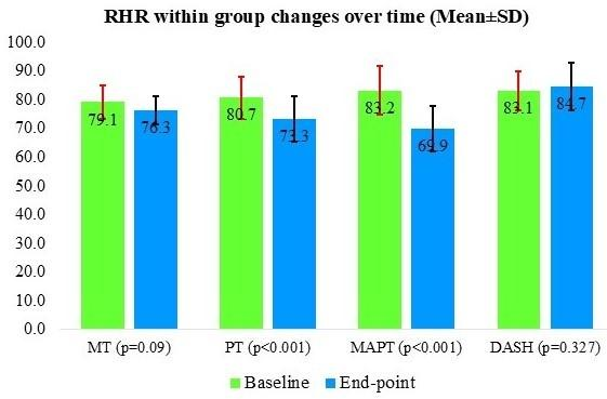
The most striking finding was the magnitude of the systolic blood pressure reduction in the combined MAPT group. Mean systolic blood pressure declined from approximately 129.7 mmHg at baseline to 116.9 mmHg after six weeks, representing a reduction of about 12.8 mmHg. The reduction was approximately 4.2 mmHg with mental training and 3.9 mmHg with physical training alone. The combined intervention also produced a substantial reduction in resting heart rate, approximately 13.3 beats per minute, compared with approximately 7.4 beats per minute following physical training alone.
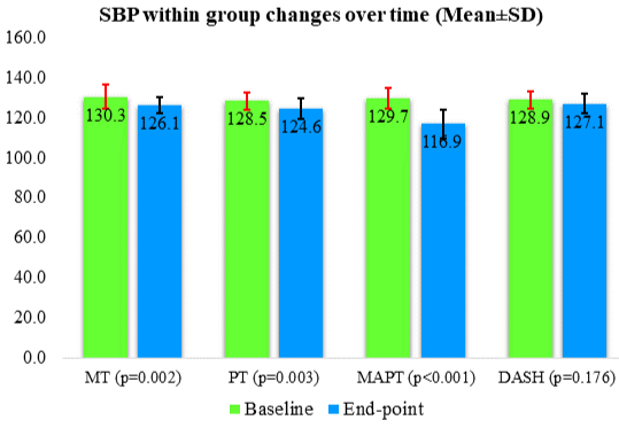
Statistically, MAPT demonstrated the strongest effect on systolic blood pressure among the interventions. Resting heart rate also declined significantly in the physical and combined training groups, with the combined intervention producing a greater reduction than the active control. Diastolic blood pressure decreased within the mental, physical and combined training groups, although the differences between groups were not statistically significant. What was particularly interesting was the apparent advantage of combining the two approaches. Exercise and mindfulness may influence cardiovascular regulation through complementary pathways. Exercise directly challenges and conditions the cardiovascular system, whereas mindfulness may help reduce excessive stress-related autonomic activation. Together, these effects may create a broader influence on cardiovascular regulation than either approach alone.
There is also a potential behavioural explanation. Physical activity and mindfulness may reinforce one another by encouraging greater awareness of the body, stress responses and daily health behaviours. However, the findings should be interpreted carefully. The combined MAPT intervention lasted 60 minutes per session, whereas the individual mental and physical training sessions lasted 30 minutes. Therefore, the larger effect cannot be attributed solely to a synergistic interaction between mindfulness and exercise. The greater intervention dose may have contributed to the observed benefit. Future studies using time-matched interventions are needed to determine whether the combination itself provides an additional advantage.
From a practical perspective, this approach is encouraging because neither component necessarily requires sophisticated equipment. Aerobic exercise can involve accessible activities such as brisk walking, jogging or treadmill exercise, while mindfulness can involve structured breathing, meditation and body-awareness practices. These activities could potentially be incorporated into university wellness programmes, workplace health initiatives or broader strategies aimed at preventing cardiovascular risk among young adults. The key challenge, however, is sustainability. A six-week intervention can demonstrate short-term physiological changes, but long-term prevention depends on whether individuals can maintain healthy behaviours. Programs therefore need to be realistic, flexible and enjoyable enough to become part of everyday life rather than being viewed as a temporary treatment. The approach should also complement, rather than replace, established strategies such as healthy eating, adequate sleep, regular physical activity and appropriate medical assessment.
There are several important next steps for this research. Larger studies involving more diverse populations are needed, including women, different age groups, individuals with overweight or obesity, and people with established hypertension. Longer intervention periods could determine whether the improvements observed over six weeks are sustained and whether longer exposure produces clearer effects on diastolic blood pressure and vascular health. Future research should also use time-matched intervention groups to distinguish the effects of the combined approach from the effects of a greater training dose. Objective monitoring of physical activity and dietary adherence would strengthen the evidence, while 24-hour ambulatory blood pressure monitoring could provide a more comprehensive assessment of cardiovascular changes than clinic measurements alone.
Ultimately, the broader message is that prevention may need to begin before hypertension becomes established. Young adulthood represents an important period during which cardiovascular behaviours and physiological patterns can be shaped. A strategy that trains both the body and the mind may offer a promising way of addressing multiple contributors to cardiovascular risk simultaneously. The findings from our study suggest that combining mindfulness-based mental training with aerobic exercise can produce meaningful reductions in systolic blood pressure and resting heart rate among physically inactive young adults with elevated blood pressure. While further research is necessary before drawing conclusions about long-term hypertension prevention, the results provide encouraging evidence for a more integrated approach to cardiovascular health—one that recognizes that the heart is influenced not only by movement, but also by the way we respond to stress.