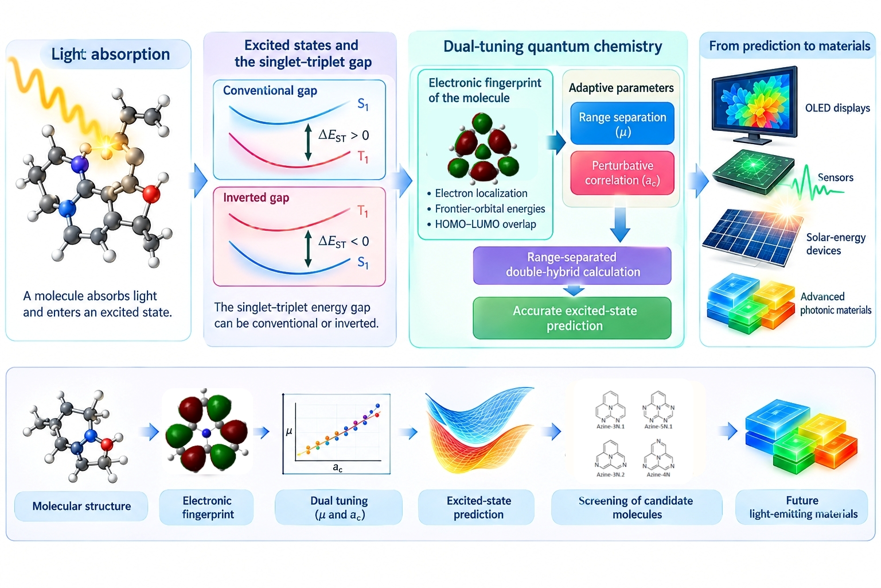
An electron in a molecule absorbs energy and is excited to an electronically excited state; this is a simple molecular event that is the basis of many technologies involving light, including organic light emitting devices, sensors, solar-energy devices and other novel photonic materials. The energy of the excited molecule may release as light, passes to another molecule, turns into heat or is used to start a chemical reaction.
If such accurate prediction of these excited states were possible, a major paradigm shift in the discovery of new molecular materials would ensue. Rather than synthesizing various candidate molecules and running them in the lab to determine their optical properties, a researcher could first try quantum mechanical computation method to design a molecule with those properties.
But this is not an easy task.
Absorption of light causes the electrons to redistribute and start to interact in a more complex manner than a simple promotion of an electron from one orbital to another. The energies of the excited states can vary slightly and the electronic character of the states may vary.
For one particularly difficult example, the singlet–triplet energy gap is defined as

Here S1 and T1 represent the lowest singlet and triplet excited states, respectively. The singlet is above the triplet in most molecules and is positive. There are molecules, however, with the opposite situation: The singlet is lower than the triplet, which yields an inverted singlet–triplet gap.
These strange systems are an extreme challenge for excited-state theories. For many applications, the conventional linear-response time-dependent density functional theory (TDDFT) is very successful, but the commonly used adiabatic approximations are inadequate for the description of effects arising from the genuine double excitations. This restriction is significant in some molecules that have singlet–triplet inversion.
A step forward in improving this description is to take the electron exchange more seriously. Range Separated density functionals separate the electron–electron interaction into a short-range and a long-range part. The short-range part is treated using the density-functional approximations, and exact Hartree–Fock exchange is added at long range. The range at which this separation occurs is controlled by a parameter
However, the value of is system dependent.
We thus investigated in our previous work system specific tuning of this parameter. We then went on to devise a range-separated double-hybrid density functional method, where we included perturbative electron correlation in the range-separated framework. This brings in another important parameter, that regulates perturbative correlation. Now, the fundamental question of whether or not to allow the correlation contribution to change, depending on the molecule.
In our recent work we have answered this question by using a dual-tuning framework.
The basic concept is to get information directly from the distribution of electron in the molecule. Using an electronic localization function (ELF) along with frontier-orbital energies, the range separation parameter is determined. The tuned μ along with the HOMO–LUMO overlap are then used to calculate the proper perturbative correlation contribution.
The dual tuning framework gives the balance of long-range exchange and electron correlation the flexibility to adapt to the molecular system itself, rather than imposing the same computational parameters on all molecules.
It has been applied to a variety of molecular systems, such as molecules with inverted singlet–triplet gaps and systems with conventional positive gaps. The overall results indicated an improvement of the agreement with the reference data. The averaged absolute error dropped from 0.07 to 0.02 eV and the averaged root mean square error dropped from 0.14 to 0.03 eV for the benchmark under consideration with dual tuning versus tuned-μ for molecules with inverted singlet-triplet gap.
Remarkably, this improvement did not come as a result of just pushing molecules towards inverted singlet–triplet ordering. The mean absolute error was decreased to 0.06 eV from 0.14 eV with dual tuning for systems with conventional positive gaps. Hence, the approach maintained its capacity to differentiate between regular and inverted electron structures. These findings point towards a more general future for quantum chemistry, in which the electronic structure of a molecule can guide the way in which the calculation is carried out.
The possibilities for impact go beyond improvements to a benchmark. The prediction of excited states could eventually be used as part of the design of new light-emitting materials. For instance, before synthesizing molecules, computational screening can be used to look for those that have specific singlet–triplet energetics. This may prove particularly useful in the design of TADF and other advanced organic emitters, where fine differences in the energetics of the excited state may play a significant role in the photophysical properties.
But there are key issues to be addressed. More elaborate and efficient treatments for electron correlation as well as solvent effects are needed for larger molecules.
The next big leap could then be the addition of adaptive quantum chemistry with AI, high throughput screening and experiments. Machine learning can make a pass for huge chemical spaces, and physics-based excited-state calculations can offer more robust assessment of promising candidates. Experimental data can then be input into computational models, which can then be used for prediction, synthesis, validation and improvement in a cycle. In the coming 10 years, this integration could slowly alter the face of computational chemistry. Use of calculations to explain properties of molecules that have been synthesized is common today. They could be of growing importance in the future in deciding which molecules to synthesize in the first place.