Robotic Telesurgery: From Concept to Clinical Reality
In the last 4 decades surgery has evolved from open techniques to minimally invasive robotic assisted approaches with progressive improvements in precision, visualisation and ergonomics. The critical barrier was the geographical dependency, with need for the surgeons to operate in the same room as the patient. This leaves underserved regions, military environments and space missions vulnerable. The telesurgery or remote surgery decouples the surgeon from operating room and serves as a transformative solution. The escalation of telemedicine during the COVID‐19 pandemic, has increased public acceptance of remote surgery.
“Robotic Telesurgery, combined with advances in Artificial Intelligence, will revolutionalise current Surgical Practice”
Lancet Commission on Global Surgery, estimates that 4.8 billion people are unable to access essential surgical services. High-quality referral centres for training and treatment remain concentrated in metropolitan cities, leaving remote or low-resource hospitals underserved. In this context, telesurgery emerges as a potential equalizer, bridging geographic barriers and expanding opportunities for both patient care and professional development. Robotic Surgery is a type of minimally invasive surgery where a surgeon uses a computer console to control the robotic arms. After more than 2 decades of experience with robotic surgery, the safety and benefits are well established, particularly while working in narrow and confined spaces such as the pelvis and the chest. The concept of telemedicine was explored by the NASA in 1970s with particular interest in treating astronauts in space. The advancements in Robotic Surgery have made the Robotic Telesurgery (or remote surgery) possible, wherein the robotic technology and wireless networking are used to connect patients and surgeons who are geographically distant. Significant advances in telecommunications and robotic surgery led to the idea that telerobotic surgery being considered a viable option. The Lindbergh operation was the worlds first telesurgery performed in 2001 between Strasbourg (France) and New York (US) using a remotely controlled robotic system connected by a dedicated high speed fibre-optic network. Widespread adoption subsequently slowed due to infrastructure costs, limited bandwidth, and unresolved ethical and legal issues. Over the next two decades, telesurgery has progressed slowly, which may have been due to the limitations of robotic systems and the lack of advanced and stable telecommunications. High infrastructure costs and unresolved ethical and legal issues also hindered the progress. The advent of 5G wireless networks has been a game changer. In recent years the advancement of robotic expertise and technology coupled with stable telecommunication has led to faster development of telesurgery. The capability of robotic telesurgery has been adequately tested recently using multiple newer platforms. Current worldwide experiences demonstrate that remote robotic surgery can be performed safely when critical requirements are fulfilled, namely with a fast, stable, and low-latency connection, properly trained personnel on both ends using advanced platforms. Robotic telesurgery is rapidly reshaping the way surgical care is delivered across the globe. By combining advanced robotics with high-speed communication networks, surgeons can now operate on patients remotely, breaking down geographical barriers and expanding access to specialized medical expertise. Mobile telesurgery units have been developed using a portable surgical robot which could be deployed near a frontline or disaster area, and expert surgeons may operate it from a safe zone.
Challenges and Benefits of Telesurgery
Wider practical implementation of robotic telesurgery will need to address the challenges of communication reliability, cybersecurity, data privacy and work within ethical, legal and regulatory frameworks. Another important challenge that hinders its adoption is latency period which is primarily a delay that exists in data transmission between the surgeon’s input and the robotic system’s response. Latency period greatly impacts telesurgery performance with an ideal value being less than 200 milliseconds. Having a backup surgical team onsite is essential for safe robotic telesurgery. This ensures that if a connectivity issue arises, a capable team can take over immediately, minimizing risk. A special consent form for telesurgery should illustrate the technical set-up, potential network-related risks, backup plans in case of technical failure, and the credentials of the remote surgeon.
Robotic telesurgery has the potential to reduce disparities in medical expertise, enable real-time surgical training through tele-proctoring and improve patient outcomes worldwide. Patients in rural or remote areas, who previously had limited access to specialists, can now benefit from procedures performed by leading surgeons located hundreds or even thousands of kilometres away. It can also facilitate the collaboration between specialist surgical teams by providing real-time interaction among surgeons from various specialties and geographical locations. Telerobotic surgery eliminates the expenses required to travel to specialized medical centres, facilitates early interventions and reduces patient stress and discomfort.
India’s First Robotic Telesurgery for Rectal Cancer: The APCC Experience
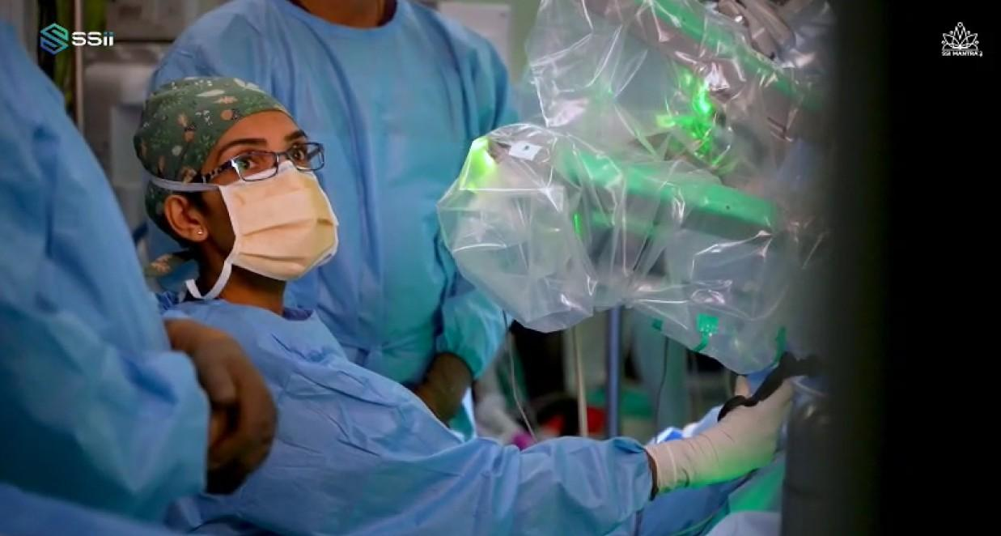
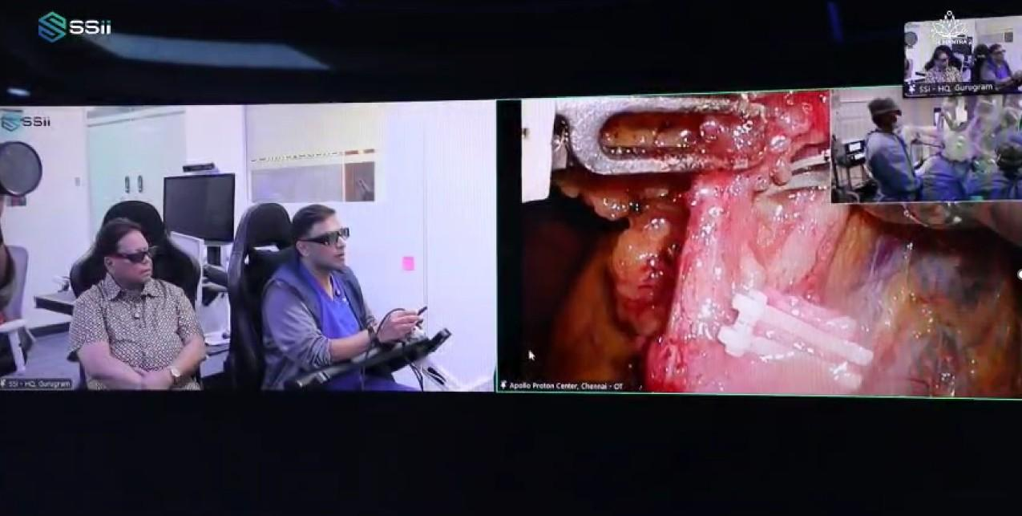
Apollo Proton Cancer Center, Chennai in collaboration with SS Innovations successfully deployed India’s indigenously developed SSI Mantra Surgical Robotic System to deliver advanced minimally invasive care with a series of Robotic Colorectal procedures. A secure dedicated wired 5G network was used with average latency of 45 ms. Collaboration achieved a major milestone with India’s first ever robotic telesurgery for Rectal cancer performed over a distance of 2200 km between Chennai and SS Innovations headquarters in Gurugram. The seamless execution demonstrated the safety, precision and reliability of the SSI Mantra systems telesurgery capabilities by integrating cutting edge made in India technology with clinical expertise. This initiative demonstrates the potential of scalable, accessible and affordable robotic surgical care for the patients across India and globally. The collaboration can be extended between multiple hospitals at multiple other cities and towns so that even surgeons with less experience in robotic colorectal surgery can be mentored and at the same time their patients can also get access to the best skill sets available.
The Future of Robotic Telesurgery
Robotic telesurgery, combined with advances in AI, high-speed communication, and supercomputing, will revolutionize current surgical practice. Artificial intelligence can overcome human visual limitations in identifying microscopic tissue boundaries particularly during cancer clearance operations. It can also provide real time navigation in identifying critical vascular and neural structures with microscopic precision thereby reducing unintentional injury to these tissues. One of the major drawbacks of robotic assisted surgery is the lack of tactile feedback. In addition to the raw visual feedback, AI has the potential to sense tissue tension more precisely and guide the surgeon in preventing unintentional tearing of tissues and overcome the absence of tactile feedback. The renewed enthusiasm for the development of telesurgery is both humanitarian and practical. Even though the world’s first robotic telesurgery happened in 2001, subsequent progress had been slow due to the limitations of robotic systems and the lack of advanced and stable telecommunications. Recent few years have seen faster development with the capability of robotic telesurgery being adequately tested using multiple newer platforms. Our team at Apollo Proton Cancer Center in collaboration with SS Innovations performed India’s first ever robotic telesurgery for Rectal cancer over a distance of 2200 km. Wider practical implementation of robotic telesurgery will need to address the technical and ethical challenges and work within legal and regulatory frameworks. Telesurgery is likely to progress from novelty to a more routine option in surgical care in the near future.