
What is the importance of nitrogen fixation?
Nitrogen is one of the essential nutrients required for plant growth. Although nearly 78% of the Earth’s atmosphere is composed of nitrogen gas (N₂), it is not present in a form that plants can directly utilize. As a result, agriculture relies heavily on synthetic nitrogen fertilizers to improve crop productivity. However, excessive use of these fertilizers has serious environmental consequences, including water pollution, greenhouse gas emissions, and degradation of natural ecosystems. These anthropogenic activities have significantly disrupted the global nitrogen cycle by adding more than double the amount of reactive nitrogen into the Earth’s ecosystems.
Biological nitrogen fixation provides a natural alternative, and one of its most productive forms is root nodule symbiosis (RNS). BNF is the only sustainable player in the global nitrogen cycle. To establish RNS, plants communicate with compatible soil bacteria. Cognate bacterial recognition by the plant ultimately leads to the formation of a new root organ called a ‘nodule’. Inside these nodules, rhizobia convert atmospheric nitrogen into forms that can be used by the plant. In return, the plant provides the bacteria with carbon compounds.
“Biological nitrogen fixation provides a natural alternative, and one of its most productive forms is root nodule symbiosis (RNS)”
Approximately 110 million years ago (MYA), RNS evolved into two main functional forms
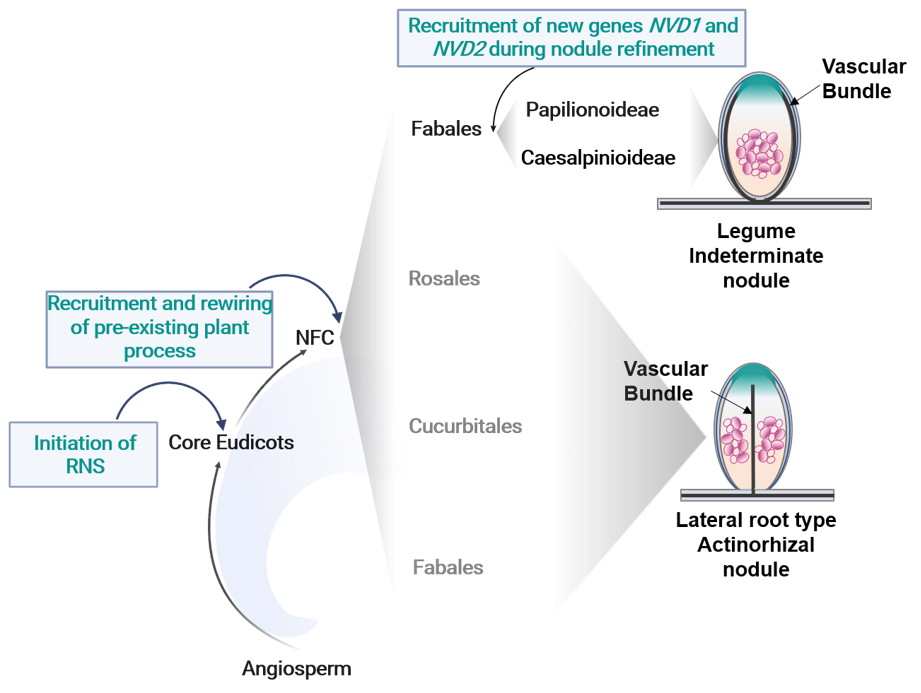
Based on Phylogenomic studies, RNS evolved ~110 MYA and is restricted to a monophyletic nitrogen-fixing clade (NFC). This clade contained four major orders: Fabales (Fa), Fagales (Fa), Cucurbitales (Cu), and Rosales (Ro), as frequently abbreviated using the acronym FaFaCuRo. In the NFC, two types of nodular architecture are mainly observed. Where Fagales, Cucurbitales, and Rosales form root nodules, the organ is structurally and developmentally similar to lateral roots. While the Fabales (Legumes) form an organ ‘sui generis’, a unique structure that does not have a perfect resemblance to a lateral root, stem, or leaf (Fig. 1).
Reusing existing genes to build a new symbiosis
Recent comparative genomic studies have provided a clearer picture of how this complex trait may have evolved in the NFC clade. For this process, rather than acquiring an entirely new set of genes, nodulation appears to have evolved largely through gene duplication, recruitment, and rewiring of genes that already performed other functions in plants. A recent report divided plant gene duplications into four major periods during plant evolution. The first duplication occurred early in the evolution of flowering plants and coincided with an ancient whole-genome duplication event. The second occurred in the common ancestor of core eudicots and was associated with the γ-whole-genome duplication. A substantial number of gene families that later became involved in RNS can be traced back to this evolutionary period. A third major peak of gene duplication occurred in the ancestor of the Papilionoideae legumes and was also associated with a whole-genome duplication event. This later period of duplication may have contributed to further refinement of the legume symbiotic program. Thus, evolutionary innovation continued after the basic RNS program had emerged. Additional genes were recruited during the evolution of legumes, helping to establish features characteristic of legume nodules.
Further refinement of nodulation in legumes
The vascular bundles of legume nodules are arranged in the peripheral region (Fig. 1). These vascular strands connect the nodule to the root and enable the transport of water, nutrients, and fixed nitrogen between the nodule and the rest of the plant efficiently, and also safeguard the enzyme nitrogenase from environmental oxygen, which is localized in the central region of the nodule.
Phylogenomic reconstruction suggests legumes recruited new genes that helped refine nodule development and internal organization, thereby making them a better home for bacteria, and improved plant benefits from symbiosis. Among these are regulators associated with nodule development and tissue organization. Importantly, Nodule Vascular bundle Development (NVD) 1 and NVD2 have been identified as genes recruited at the origin of the legume subfamily, suggesting that they may represent part of the later evolutionary refinement of the nodulation program.
NVD1 and NVD2: Fine-tuning the architecture of the legume nodule
In our recently published work in New Phytologist, we identified two genes, NVD1 and NVD2, and elucidated their molecular mechanisms and functional roles in the Medicago nodule. We identified NVD1, a basic helix–loop–helix (bHLH) transcription factor, as an important regulator of this organization. Disruption of NVD1 caused the vascular strands to shift away from the periphery of the nodule, akin to an intermediate between a ‘lateral root-type nodule’ and a ‘legume-type nodule’. These architectural defects were accompanied by reduced nitrogen-fixation capacity and decreased plant biomass. We further identified NVD2, an HLH transcriptional regulator, as a downstream target of NVD1. Notably, NVD2 lacks the basic region of the DNA-binding domain and thus functions only via protein-protein interaction. NVD1 directly activates NVD2 expression, while NVD2 interacts with NVD1 to regulate its transcriptional activity via a negative feedback loop (or negative feedback autoregulation). Mutations in NVD2 also resulted in abnormal vascular organization. Our work further linked this regulatory module to the plant hormones auxin and cytokinin, thereby demonstrating how transcriptional regulation and hormonal signaling are integrated to establish the internal architecture of the nodule. The complete disruption of this circuit results in a significant reduction in biological nitrogen fixation (BNF), and these nodules are barely capable of BNF. Full disruption of this circuit renders the Medicago root vasculature simple and Arabidopsis-like. Thus, NVD1 and NVD2 are two key evolutionary innovations that refine legume nodules. This refinement created a supportive and comfortable home for the incoming bacterial partner, which is essential to a thriving, mutually rewarding relationship.
From evolutionary history to future crop improvement
The NVD1-NVD2 regulatory module, therefore, adds another layer to our understanding of RNS evolution. The earliest stages in the evolution of nodulation appear to have involved ancient gene duplication and the recruitment of pre-existing signaling pathways. Later evolutionary innovations further refined the development, organization, and function of the legume nodule. Understanding these genetic innovations is important for future efforts to improve sustainable agriculture. In the short term, this newly learned information can be used in the legume breeding program, where these genes and their expression levels can be monitored to identify improved nitrogen-fixing legume nodules. Further, the long-standing goal in RNS is to reduce cereal crops’ dependence on synthetic nitrogen fertilizers by enabling them to obtain a greater proportion of their nitrogen through biological processes. Identifying genes such as NVD1 and NVD2 helps us understand the individual genetic components required to construct and organize this specialized organ. Each newly identified regulator adds a piece to the evolutionary puzzle of how legumes build a sophisticated functional ‘home’ for nitrogen-fixing bacteria.