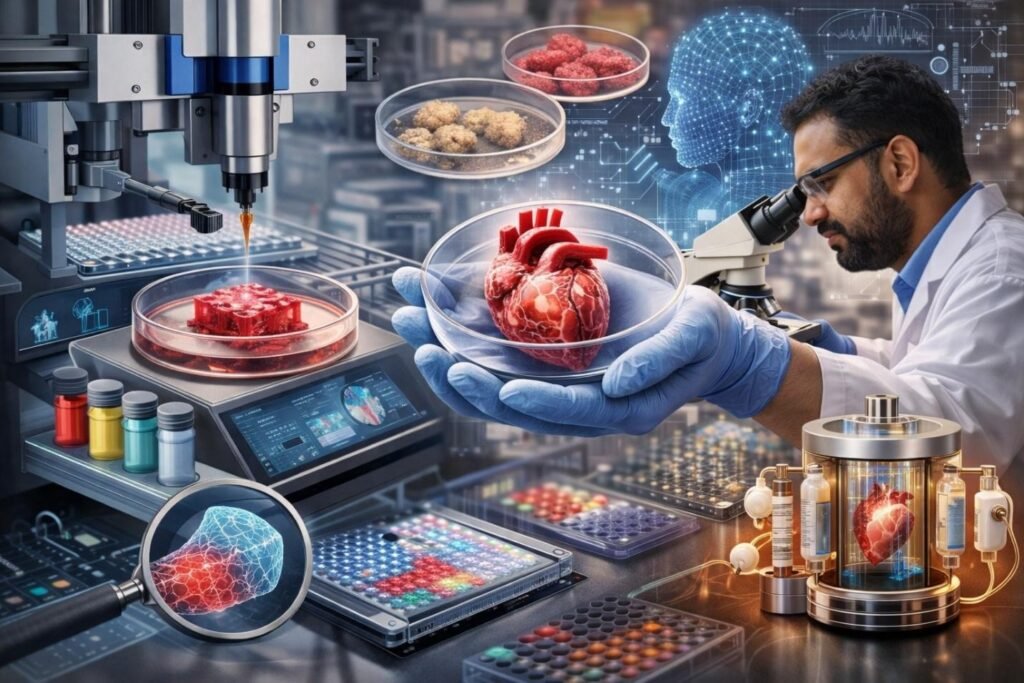
Modern medicine has transformed the way we treat disease, repair tissues, and extend human life. Yet, one fundamental challenge persists: our limited ability to fully restore or replace damaged human tissues and organs. From the global shortage of donor organs to the constraints of synthetic implants, there is a growing need for solutions that go beyond treatment and move toward true regeneration. In this context, 3D bioprinting is emerging as a powerful technology that could redefine the future of healthcare. At its core, 3D bioprinting is an advanced biofabrication approach that enables the precise placement of living cells, biomaterials, and biological signals in a layer-by-layer manner to create tissue-like structures. Unlike conventional 3D printing, which uses plastics or metals, bioprinting relies on “bioinks” which are engineered materials that mimic the natural cellular environment. Over time, these bioprinted constructs can mature into tissue-like systems, offering a unique platform to replicate aspects of human biology outside the body.
“3D bioprinting is evolving from structural fabrication toward intelligent, immune-integrated, and clinically translatable living systems.”
One of the most promising applications of 3D bioprinting lies in tissue engineering and regenerative medicine. Researchers are already developing bioprinted skin for wound healing and cartilage constructs for joint repair. Looking ahead, the ability to fabricate patient-specific tissues using a patient’s own cells could significantly reduce dependence on donor organs and minimize immune rejection. This represents a shift toward personalized regenerative therapies, where treatments are tailored to individual patients rather than standardized across populations.
Beyond transplantation, 3D bioprinting is also transforming drug discovery and disease modeling. Traditional testing systems often fail to capture the complexity of human physiology, contributing to high failure rates in clinical trials. Bioprinted tissues provide a more physiologically relevant alternative, enabling researchers to study disease progression and evaluate therapies in realistic environments. Notably, regulatory developments such as the FDA Modernization Act 2.0 (2022), which removed the mandatory requirement for animal testing, along with subsequent legislative efforts under the proposed FDA Modernization Act 3.0, are accelerating the adoption of human-relevant nonclinical models, including organoids, microphysiological systems, and emerging bioprinted platforms. Advances in high-throughput biofabrication are particularly significant in this context. Recent studies have demonstrated integrated platforms capable of rapidly organizing cellular building blocks with high precision and viability, significantly accelerating tissue fabrication while maintaining functional integrity (Singh et al., Bioactive Materials, 2025; Nature Communications, 2024). Such developments are helping bridge the gap between laboratory research and scalable, translational applications.
Despite these advances, a critical challenge remains: ensuring that bioprinted tissues are not only structurally accurate but also functionally viable over time. Living tissues require vascular networks to supply oxygen and nutrients, and replicating this level of complexity remains a major scientific hurdle. Equally important is the interaction between engineered constructs and the host immune system, which ultimately determines whether an implant integrates successfully or fails.
To address this, the field is undergoing an important shift from designing materials that are simply biocompatible to developing systems that actively engage with biology. Immuno-engineering is emerging as a key strategy, where biomaterials are designed to guide immune responses toward healing and regeneration rather than inflammation or rejection. By incorporating bioactive signals such as extracellular vesicles, cytokines, or immune-modulatory polymers, bioprinted constructs can become active participants in the regenerative process rather than passive implants.
At the same time, the integration of artificial intelligence (AI) with bioprinting technologies is opening new frontiers. AI-driven systems can optimize printing parameters, monitor construct quality in real time, and improve reproducibility. Machine learning approaches are also being used to predict optimal fabrication conditions and design more efficient tissue systems, enabling a transition toward intelligent and adaptive biofabrication platforms (Advanced Functional Materials, 2025).
From an industry perspective, 3D bioprinting has already moved beyond a purely academic concept and is rapidly emerging as a translational sector. The global 3D bioprinting market size was valued at USD 2.3 billion in 2023 and is projected to reach USD 5.3 billion by 2030, growing at a CAGR of 12.5% from 2024 to 2030. This growth is driven by limited number of organ donors, increasing adoption in pharmaceutical research, personalized medicine, and advanced biomaterials development. Notably, the most commercially mature segment today includes drug-testing platforms, tissue models, and biofabrication tools, which are already delivering real-world value.
However, it is important to distinguish between 3D-printed medical devices, which are already widely used in clinical settings, and living bioprinted tissues, which present additional biological and regulatory challenges. The path to clinical translation for bioprinted systems is likely to follow a stepwise progression. Early applications such as skin substitutes, wound healing systems, and localized cartilage constructs are expected to reach broader clinical adoption in the late 2020s to early 2030s, supported by ongoing technological and clinical advancements. In contrast, more complex applications, particularly fully vascularized and functional organs, remain a longer-term goal. Based on current scientific and regulatory progress, such systems are more realistically expected in the mid-to-late 2030s or beyond.
Looking ahead, the future of 3D bioprinting will be defined by convergence. Advances in stem cell biology, biomaterials science, computational modeling, and engineering are coming together to enable increasingly sophisticated systems. Emerging technologies such as smart biomaterials, high-throughput platforms, and AI-driven biofabrication are pushing the field toward constructs that are not only structurally accurate but also functional, adaptive, and clinically translatable.
“The challenge is no longer to build tissues, but to design biology that can function, adapt, and truly belong.”
For young researchers and students, this field offers an exciting opportunity to contribute to meaningful healthcare innovation. 3D bioprinting is inherently interdisciplinary, requiring expertise across biology, engineering, materials science, and data science. Future progress will depend on problem-driven research, identifying real clinical challenges and developing solutions that are scalable, affordable, and translatable. Equally important is an understanding of regulatory pathways and clinical needs, which are essential for bridging the gap between innovation and real-world impact. In conclusion, 3D bioprinting represents a powerful convergence of engineering and biology with the potential to transform modern medicine. While significant challenges remain, advances in high-throughput biofabrication, immune engineering, and intelligent systems are steadily bringing this vision closer to reality. The future of medicine will not be defined solely by our ability to treat disease, but by our ability to engineer living systems that restore, regenerate, and integrate seamlessly within the human body.